

Younger Muslims embrace Islam as marker of political resistance
While only a distinct minority of American Muslims embrace Islamism, the ideology seeking to capture state power in order to impose Islamic law and rejecting any separation between religious authority and political life, younger, more assimilated Muslims are increasingly drawn to political radicalism, writes Reihan Salam in the Free Press (June 23). The incidents of Islamism and extremism that the U.S. has recently seen are more the result of faulty vetting in granting visas to some Muslim immigrants and radical influences when they arrive. In contrast, the immigration trajectory of American Muslims has been broadly seen as a success story. According to a 2025 survey from the Institute for Social Policy and Understanding (ISPU), 36 percent of Muslim Americans hold a bachelor’s degree or higher, roughly comparable to the Protestant share and above that of white evangelicals and Catholics, Salam notes. Nearly 25 percent report household incomes above $100,000, broadly in line with those of other religious communities, and well above the incomes of white evangelicals. Survey research has found that American Muslims, in comparison to Muslims in the UK and France, are more tolerant toward other religious faiths, more likely to identify with the country they live in, and less likely to live in Muslim-majority enclaves, even after adjusting for income, education, age, and sex.
Yet at the same time, Salam cites political scientists Justin Gest and Richard Nielsen who see an “immigration paradox”: American Muslims are less trusting of societal and government institutions than their European counterparts, which they attribute to the greater integration of American Muslims. In other words, the more you see a society as your own, the more entitled you feel to voice frank opinions about its supposed deficiencies. It is also the case that a significant and growing share of Americans raised Muslim have quietly stopped identifying with the faith altogether. “For a subset of younger American Muslims, the faith has become less a set of devotional practices than an emblem of resistance to Westernness and whiteness,” Salam writes. He cites a survey from the Othering &Belonging Institute at UC Berkeley that found 60 percent of Muslim respondents believing that Islamophobia in the United States is a very big problem, with concern about Islamophobia being most acute among younger, female, and U.S.-born Muslims—“the very Muslims most thoroughly incorporated into the American mainstream.”
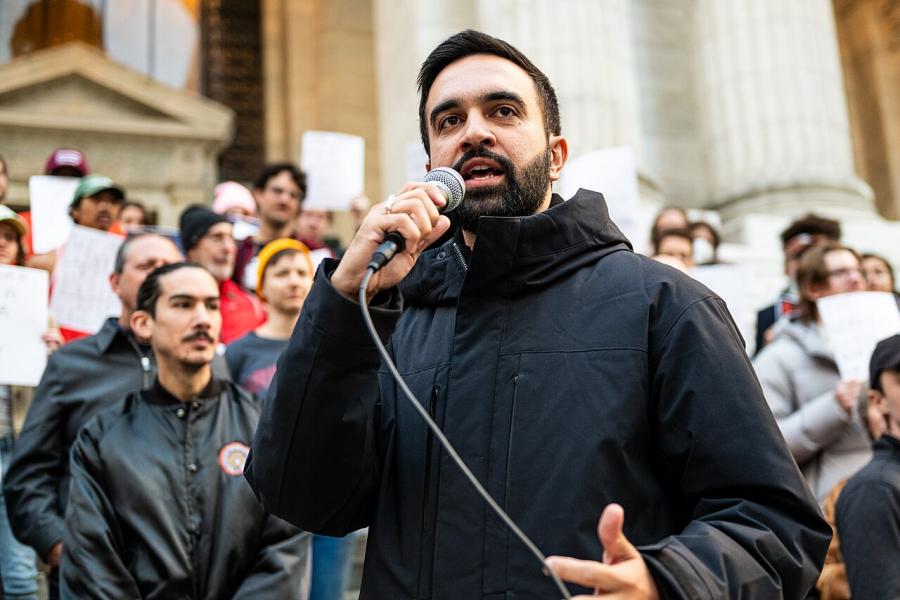
Taken together, their secularism, political radicalism and belief that America is rife with Islamophobia make the younger generations of Muslims very different than the older ones. Under the leadership and influence of New York Mayor Zohran Mamdani, they embrace an ideology of “Third Worldism, a fusion of anti-Zionism, anti-Westernism, and anti-capitalism that places the sacralized victimhood of Palestinian Arabs at the center of a larger struggle against American imperialism.” It is what political scientist Robert Leiken has called “adversarial assimilation,” a process by which incorporation into American institutions produces not attachment to patriotic narratives of American freedom, individualism, and benevolence but hostility toward them. Salam adds that this phenomenon is especially “common among younger South Asians broadly—a highly educated, upwardly mobile group increasingly overrepresented in the uppermost echelons of the American Left.” He points to the ISPU’s 2025 American Muslim Poll showing that 59 percent of Asian Muslims identified the war in Gaza as their top policy priority in the 2024 presidential election, as opposed to only 32 percent of white and 12 percent of black Muslims. This ideology’s ability to reach across racial, religious, and ethnic lines is what makes it more durable than Islamism. But Salam concludes that it can also serve as a “permission structure for Islamist violence.”