

When the Latin Mass goes left
Published in the French Catholic weekly La Vie (May 22), an article by Timothée de Rauglaudre reports on the discreet and somewhat paradoxical phenomenon of left-leaning Catholics—anticapitalists, ecologists, and LGBTQ people among them—who are drawn to the traditional Latin (Tridentine) Mass, a rite often associated with the political right. The article builds its case through interviews with roughly a dozen young believers, most in their 20s and early 30s, several of them recent converts. Their attraction to the rite is largely aesthetic and spiritual rather than political. Several cite the care given to liturgical detail, Gregorian chant, vestments, and ceremonial gesture. Others value the contemplative atmosphere, with one interviewee on the autism spectrum finding the Latin Mass calmer and less stimulating, and several appreciating that the rite feels less centered on the priest’s personality. A recurring theme is the celebration ad orientem (with the priest facing the same direction as the congregation, toward the cross), which many perceive as less “clerical” and less performative than the priest facing the people in the ordinary rite. The theologian Grégory Solari, quoted in the piece, observes that younger Catholics have a more fluid relationship to liturgy and that attraction to traditionalist settings does not necessarily entail adherence to the political ideas commonly associated with them.
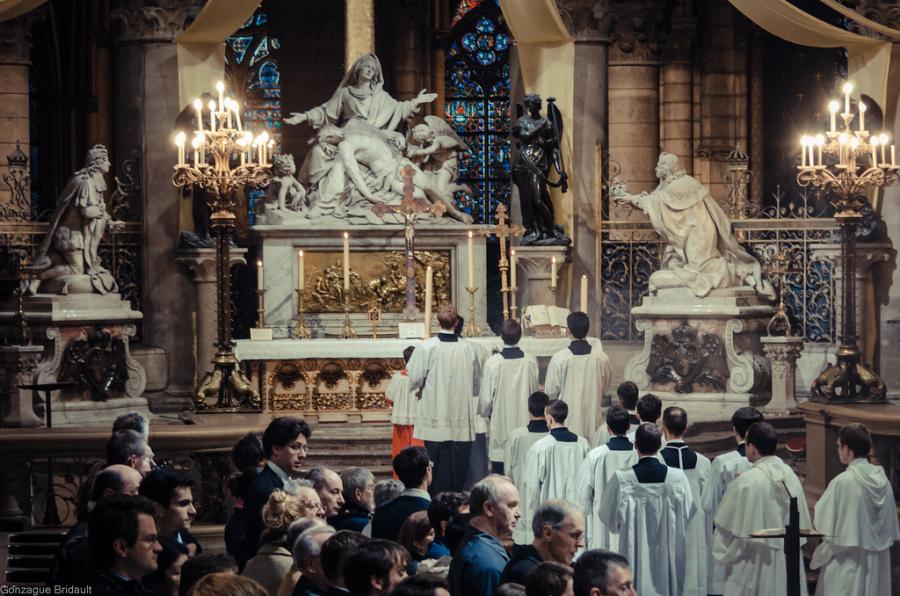
The article does not downplay the tension these believers experience. Many report having to mentally tune out homilies they find moralizing or reactionary—for example, sermons attacking “gender theory” or modernity. Several describe encounters with the harder political edges of traditionalist milieus: a Cameroonian woman reports racist remarks; one interviewee was unsettled by a requiem Mass held for a man with reported far-right connections; another was disturbed by neofascist flyers distributed outside church and by royalist militants providing security at processions. These experiences leave many feeling isolated, and some express a wish for traditionalist Masses populated by people who share their left-wing views. However, some report having also been able to find some Tridentine celebrations with a less politicized background. Overall, the article frames this minority as evidence of a looser, more individualized relationship to liturgy among younger generations, in which liturgical preference may also become decoupled from political identity.