

Spiritism declining, Umbanda rising in Brazil
The 2022 Brazilian census reveals a recomposition within the field of “mediumistic religions,” with Spiritism’s share of the population declining from 2.2 percent to 1.8 percent and identification with Umbanda growing, report André Ricardo de Souza and Bryan Henrique Pinto (Federal University of São Carlos) in REVER: Revista de Estudos da Religião (Oct. 30). They point out that the decline of Spiritism is not only due to continuing growth among the religiously unaffiliated but is also a consequence of the shift in identification towards Umbanda, which nearly quadrupled from 0.21 percent to 0.8 percent of the population. The authors caution, however, that individuals did not necessarily move directly from one religion to the other. Seeing 2018 as a turning point, they point to three main factors behind these changes. First, there was the scandal surrounding the healer-medium João de Deus, who was arrested in 2018 on multiple sexual abuse charges. He had never called himself a Spiritist, but the public widely associated him with Spiritism.
A second factor was the politicization of Divaldo Franco, the movement’s leading figure after Chico Xavier’s death. At a Spiritist congress in February 2018, in remarks broadcast live, he called “gender ideology” a communist thesis. Later, he criticized vaccination before being vaccinated himself, and he published a channeled book that hinted at a laboratory origin for Covid and endorsed ineffective “early treatment.” The authors contrast this with Chico Xavier’s 1971 television plea for respect towards homosexuals, which had helped give Spiritism its image as rational and welcoming. The third factor is the estrangement of young people, who find Spiritist public sessions austere and dull. The authors also point to a racial dimension. Spiritist founder Allan Kardec’s phrenology-influenced passages led to a 2006 agreement with federal prosecutors in Bahia requiring explanatory footnotes to 106 passages. When a left-wing Spiritist collective published “anti-racist editions” of Kardec’s works in 2020–21, the largely conservative Spiritist milieu overwhelmingly rejected them.
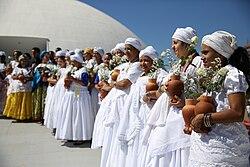
The result is an aging membership, the largest Spiritist age bracket being 60–69, while 36.8 percent of the adherents of Afro-Brazilian religious groups are under 29. Drawing on Camargo’s notion of a “mediumistic continuum,” the authors argue that Umbanda gives former Spiritists continuity in mediumship, charity, and healing, but in a more festive, embodied and musical form. It is also more open to LGBTQIA+ people. In São Carlos, most of the Umbanda mediums they studied had come from either Catholicism or Spiritism, and most were young and LGBTQIA+. Umbanda also benefits from the growing valorization of black identity and from public recognition of “religious racism.” This has encouraged people to openly declare an affiliation they previously concealed or reported as “Spiritist,” helped by mobilization during the census period. The growth is not exclusively among black Brazilians, however. Unlike in 2010, Umbanda no longer appears to be losing adherents to Candomblé and Pentecostalism.
(The article, in Portuguese, can be accessed on REVER’s website )