

Outspoken faith finds a niche in Silicon Valley
“What began with marquee names like Peter Thiel and Y Combinator’s Garry Tan being public about their faith has started bleeding into other areas of the tech industry. Silicon Valley’s rank and file are embracing Christianity, searching for community, networking opportunities, and answers to questions that have been raised by AI. In typical SV fashion, they’re doing it via meetups and events,” reports Zara Stone in the San Francisco Standard (June 9). “Experts say that as large language models get more powerful, the search for deeper meaning intensifies. ‘People are going back to church [to learn how to] demarcate the human from the machine in order to see meaning in human activity,’” according to Robert Geraci, a professor of religious studies at Knox College. Faith leaders are taking an interest in AI as well, most notably Pope Leo XIV, with his encyclical Magnifica Humanitas. “There have been six-week courses on ‘How to engage with AI as a Christian,’ a Catholic line-dancing crew run by a Tesla engineer, an Anthropic summit on God and AI, and a ‘Christians in Tech’ mixer at Salesforce Park.”
“On paper,” Stone adds, “San Francisco’s Christian population is roughly the same size as it was a decade ago,” with the modern Bay Area being “famously irreligious.” But Silicon Valley has had a longstanding penchant for spiritual experimentation—from psychedelic use in the 1970s to Burning Man in the 1990s and, more recently, the effective altruism movement, which advocates using data to determine the maximum good. This has provided an opening to questions about God. Members of a Catholic parish created The Hamilton Society, which hosts intellectual discussions that have grown from 40 attendees at the first event to more than 600 and include big-name guests like Anduril’s Trae Stephens. “We have product market fit with what people want in San Francisco,” said Federico Chavez-Torres, one of the founders. Geraci added that for Christians in tech, AI is a theological problem to grapple with. “People are going to work day after day and feeling anxious about the very things that they’re doing. That might lead them toward…other kinds of metaphysical answers.”
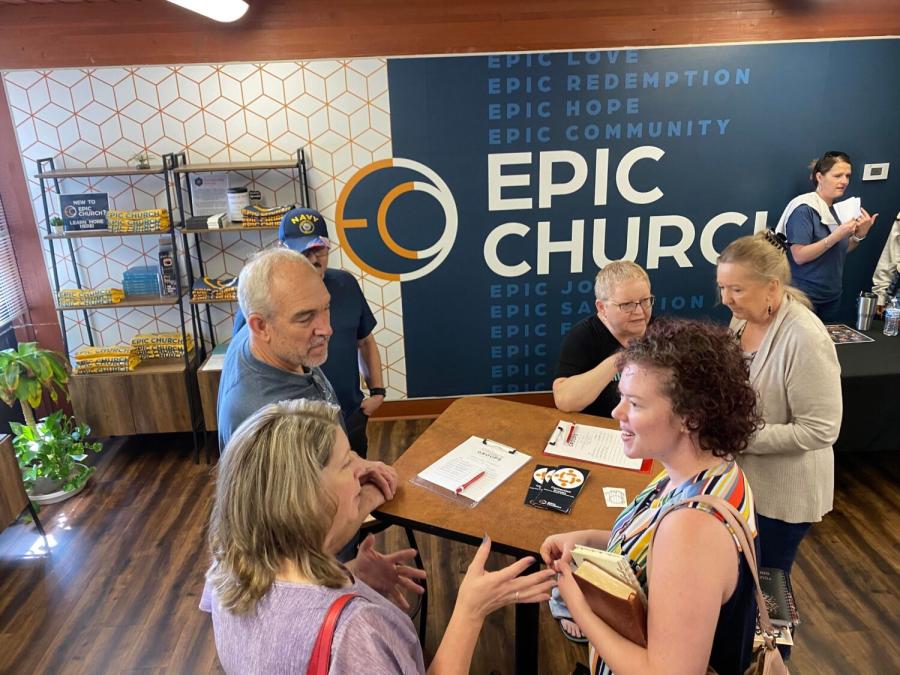
Clergy interviewed reported significant church growth among tech workers. At Epic Church in SoMa, attendance is more than 30 percent higher than before the pandemic, according to the church’s pastor, Ben Pilgreen, and Sunday services serve over 1,000 people. But it is also the case that the growing influence of Christianity in the Bay Area has not escaped the AI companies, which are actively courting religious leaders. In late March, Anthropic invited around 20 Christian theologians, academics, and venture capitalists to its Howard Street headquarters for a two-day summit on God and AI. One of the participants, Paul Taylor, an Oracle product manager turned pastor and cofounder of the Bay Area Center for Faith, Work & Tech, has launched 4AI Cohort, a six-week breakfast course in Palo Alto for Christians grappling with working in and around AI. Many of those interviewed said there is a new acceptance about being openly Christian in tech, which previously carried social and professional risk. A recurring concern among members of Epic Church has been how to be openly Christian at work, “without being cringe about it,” Stone reports.
AI is also literally directing people to church, according to Pastor Pilgreen. “Most of our new congregants found us through ChatGPT.”