

Islamic piety and influence now a contender at World Cup
While Muslim soccer players have entered elite ranks and have long observed their faith on the field and off, this year’s World Cup shows how soccer is no longer “the sole purview of Christendom...[S]occer has peacefully and with little fanfare become a game shared between the world’s two and a half billion Christians and two billion Muslims. Club teams are owned by countries without an established church or millennia of Christian hegemony, and elite teams are increasingly populated by people of other faiths, Islam above all,” writes Dan Friedman in the online religion magazine ARC (June 9). Where once fans would only see players from Europe and Latin America cross themselves and point to heaven to thank God after scoring a goal, they are now “growing accustomed to seeing Muslim players like Mohammad Salah perform a sujood, kneeling and placing his forehead on the pitch, to thank Allah. With increasing numbers of non-Christian players from the continent and beyond joining rosters in Europe, different competitions across the continent have formalized their inclusion of Muslims by setting aside prescribed match time to take in food [during Ramadan],” he adds.
The balance of financial power has shifted in the world game, with Europeans no longer owning many of their most storied club teams: Americans see such ownership as cash cows, while investors from the Arabian Peninsula, like the Qataris, are looking for prestige. The change in the religious composition of the players can be seen in the front-running French team. In 1998’s victorious team, nine of the squad were immigrants, and players’ families came from mainland France, the Basque Country, Western Europe, and French overseas territories, as well as from North and West Africa. By the time France won again in 2018, 15 of the 23 squad members had African backgrounds, with seven Muslim players. But with Morocco reaching the semifinals in 2022, “no longer do Muslim or African players have to play for European countries to have success on the world stage.”
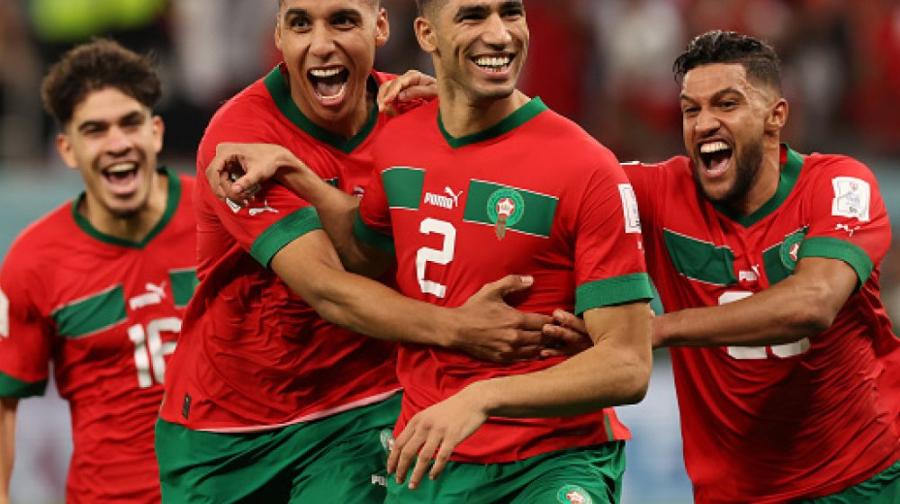
A record number of majority-Muslim countries were represented in this year’s World Cup: Algeria, Saudi Arabia, Qatar, Jordan, Iraq, Bosnia and Herzegovina, Morocco, Egypt, Senegal, Tunisia, Turkey, and Iran. There is both conflict and opportunity seen in the new Muslim representation. Muslim players have cited their faith in opposition to LGBTQ inclusion events, even as their presence is seen as educating crowds about inclusion and understanding. Friedman concludes that “there is a clear geographical and cultural dissonance between the excellence of (mostly African) Muslim players and the political machinations of Arabian oil heirs.” In the 12 years between 2022 and 2034, three of the five tournaments will be hosted by Muslim countries, which could possibly result in one being held in Mecca. Such countries as Qatar and Saudi Arabia “win power and status through oil-fueled bribery, then use religious solidarity as a cover.”