

Evangelical center of gravity shifting toward populism?
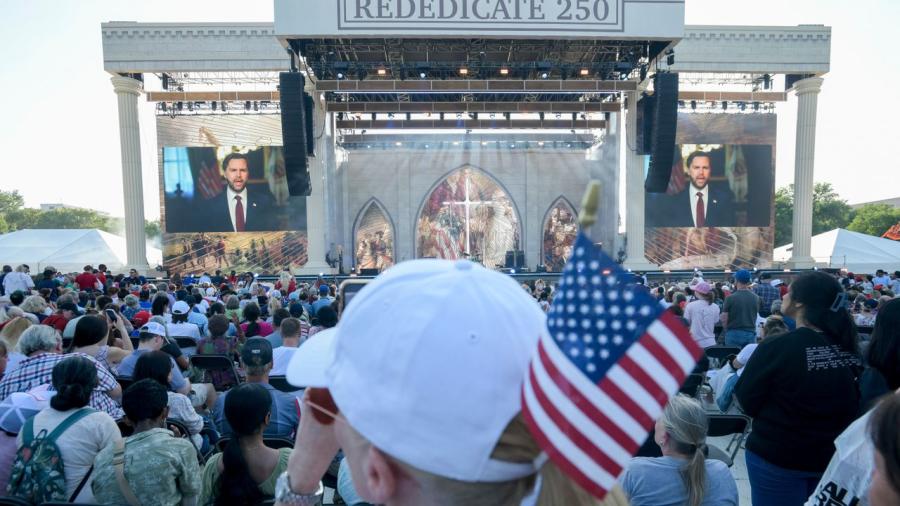
The media and other observers have struggled to put a face on Christian nationalism and Christian populism, but Pentecostal-Charismatic and Baptist traditions come closest to filling that niche, writes Dale Coulter in the newsletter The Protestant Mind (May 26). Challenging the diffuseness and accuracy of the “Christian nationalist” label, he sees a recent gathering in Washington, “Rededicate 250: A National Jubilee of Prayer, Praise, and Thanksgiving,” as offering a clear public expression of what would be more accurately described as a new evangelical populism than Christian nationalism. Rededicate 250 was sponsored by Freedom 250, the organization that is coordinating celebrations of America’s semiquincentennial during 2026. There were over 35 speakers at the event, not including worship leaders or teams. “Of those thirty-five, twenty-one came from Southern Baptist, non-denominational, or the Pentecostal-Charismatic (P-C) movement,” Coulter writes. “Including worship leaders, the P-C representation increased to over one-third of participants. The participants mostly represented the populist side of evangelicalism, which is undergoing a radical shift.” Among the speakers at Rededicate 250 were white, black, and Latino Pentecostals, such as Samuel Rodriguez, Kelvin Cobaris, and Jentezen Franklin, and neo-Charismatics like Trump’s spiritual advisor Paula White-Cain, Guillermo Maldonado, Lou Engle, and Dutch Sheets. While these leaders have been identified with the New Apostolic Reformation (NAR), Coulter sees several key figures pulling away from that label. “It’s better to see them as neo-Charismatic in their theological commitment to the offices of apostle and prophet, the Seven Mountain Mandate, and strategic-level spiritual warfare,” he writes.
There was also a contingent of Pentecostals and neo-Charismatics identified with the Calvary Chapel network of churches. Coulter adds that many Calvary Chapel pastors have become politically engaged “partly through the influence of men like Rob McCoy, who pastored Godspeak Calvary Chapel in Thousand Oaks, California, and who was also an important influence on Charlie Kirk.” Meanwhile, the Southern Baptists were represented by Robert Jeffress, Jonathan Pokluda, Jack Graham, Jonathan Falwell, and Speaker of the House Mike Johnson. “Even though they are not technically Baptist, one could include non-denominational speakers who are not part of the Pentecostal-Charismatic movement. They include Sen. Tim Scott, Franklin Graham, his daughter Cissie Graham Lynch, and Lorenzo Sewell.” Coulter finds “very few representatives of Reformation Protestant traditions. Most speakers came from the Protestantism of dissenters—those disestablishment contrarians who espoused freedom of conscience in the face of establishment churches….It’s the new world of evangelical populism where the movement’s ferment resides. It’s also where all the growth is occurring.”
Coulter doubts that most of these evangelical populists are “Christian nationalists in any formal sense of having a working theory about how government should function under Christ. They do not wish to rehabilitate some older form of Christendom.” Rather, their motives are based on local issues. Calvary Chapel’s recent political involvement, for example, resulted partly from their California context and their reaction to Gavin Newsome’s Covid policies, especially that Christians could not gather for worship. These evangelical populists want “to live their Christianity out loud in the culture, not simply attend Bible studies and church. They want Christian ministers, not simply lay persons, to enter politics and protect Christian interests, especially on moral matters like marriage and life. They resist globalism and secular liberalism, but they have not rejected the classical liberalism that makes their own non-conformity possible,” Coulter writes. Mainline and evangelical-left critics continue to view such evangelical populism through an “older lens in which the battle lines are between white and black Protestants and [between] fundamentalists and modernists…without the slightest concern about the diversity within the P-C side…This paradigm no longer works…the evangelical future is mestizo.” Coulter sees both the Reformed and Wesleyan traditions as too divided about populism and politics to generate the kinds of activism present among the Pentecostals, Baptists, and non-denominational churches. Even such a conservative body as the Presbyterian Church in America is locked in debate and conflict about Christian nationalism and the Trump presidency. He adds that “Wesleyanism is a broad tradition anchored in populism on its Pentecostal and Holiness right flanks, and in mainline liberalism on its Methodist left flank. These crosscurrents within the broad Wesleyan tradition have created a kind of paralysis in which Wesleyans have not developed a political theology.”