CURRENT RESEARCH
A new study finds that while American teenagers and young adults use digital media constantly to find comfort, explore belief, and stay connected across every tradition, these digital resources supplement rather than supplant in-person communities and the trusted people—faith leaders, parents, peers—they still turn to for guidance. The survey, conducted by the Center for Scholars & Storytellers at the University of California, Los Angeles (UCLA), looked at how American adolescents and young adults relate spirituality, religion, and digital media. Funded by the Templeton World Charity Foundation, the study was based on 24 focus groups with 86 participants aged 14–24 and a national survey of 2,001 respondents aged 16–24. Ninety-seven percent of religious young people and 80 percent of non-religious young people reported having been “spiritually moved, inspired, or comforted” by online content; 67 percent of religious young people and 78 percent of non-religious young people said this content had helped them discover new ideas or practices; and 68 percent of religious young people said they had connected with peers through it. But more than 60 percent of religious young people reported that their practice remained “rooted in traditional settings” or combined in-person gatherings with digital media, and that family and community leaders remained their primary spiritual guides, while online scholars, AI chatbots and searches ranked lowest. Nearly 80 percent nonetheless used faith apps at least occasionally.
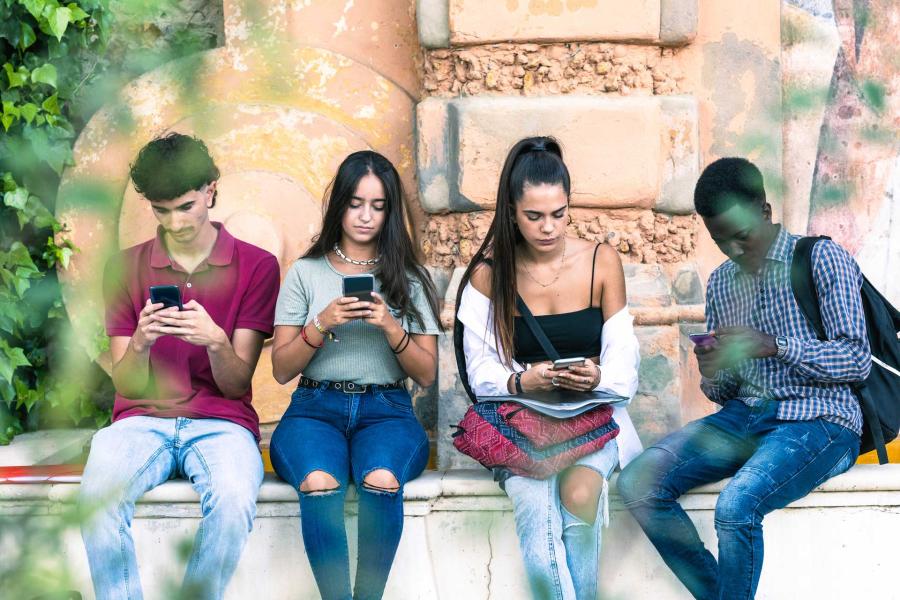
Authenticity in the representations of spiritual or religious traditions, people, or communities is located more in online expressions than on television or film for these young people. Religious and non-religious young people are consuming a significant amount of religious and spiritual content online. “About 50 percent of religious respondents said that at least half of the media (i.e. music, social media, online videos, TV shows, movies, etc.) they consume is religious or spiritual.” But the study also revealed “a strong desire from teens—and clear opportunities for creators—to establish safe online communities,” notes Elizabeth Kivowitz (Phys.org, August 18). Only 23–29 percent of religious and 11 percent of non-religious respondents reported a strong online faith community, and 55–58 percent wished creators would build one.
The report on The Future of Faith: Young People, Media, & Spirituality can be downloaded from the website of the UCLA Center for Scholars & Storytellers
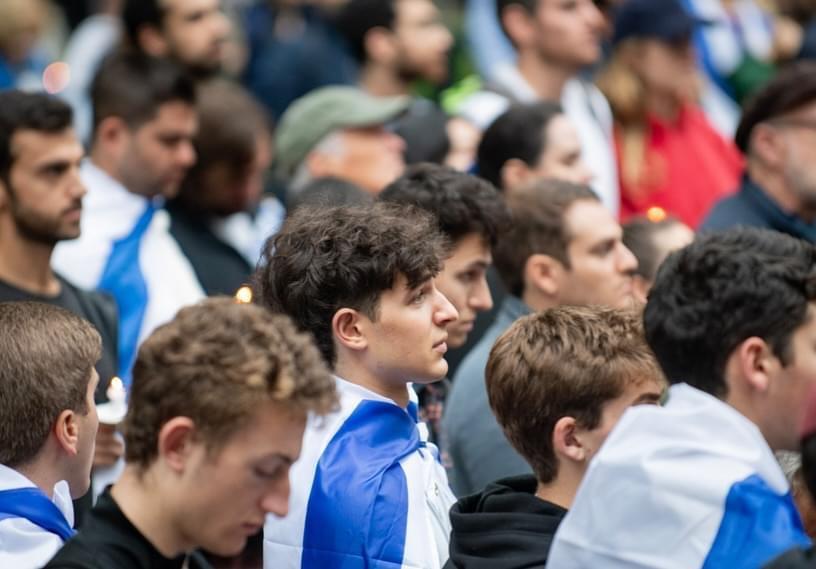
A new survey finds that about half of American Jews have experienced antisemitism since the October 7 attack—a larger number than usually reported. At a preconference on antisemitism at the meeting of the American Sociological Association in early August, attended by RW, Ira Sheskin of the University of Miami presented a paper based on a survey he conducted for the Combat Antisemitism Movement of 1,060 Jews who were involved in a synagogue or other Jewish organization or who were online with the Jewish community. His survey showed a more significant effect of the October 7 attack than other surveys. Previous studies on antisemitism and October 7, such as by the Anti-Defamation League (ADL), have reported on the number of incidents believed to be antisemitic. Sheskin’s approach looked at the impact rather than single incidents of antisemitism. He gave the example of antisemitic graffiti being written on a Hillel building on a college campus; it is reported as one incident yet it can have an impact on 2,000 Jewish students. Using that measure, Sheskin found that one in four Jewish college students reported being made to feel uncomfortable in class by their instructors. Outside of colleges, one in four did not go to Jewish events because of fear of antisemitic attacks. Sheskin adds that males, Orthodox, those Jews involved in religious life, and Republicans reported experiencing the most antisemitism in the past year and that this effect declined with age.
The October 7 attacks and the subsequent war in Gaza and the Middle East have somewhat paradoxically led to an increase of interest and conversions to Judaism, with such religious transitions marked by personal seeking and a quest for a sense of community, according to a study by Lina Liederman of the Wolff Institute of Oxford. In a paper presented at the New York meeting of the Association for the Sociology of Religion, which RW attended, Liederman found that these conversions were not primarily a reaction to current events. Rather, they were the result of a long search starting well before October 7 and marked by questioning and interest in the practices of prayer, Shabbat observance, study, holiday celebrations, and participation in communal life. The study, which was based on 19 qualitative interviews and 14 conversion statements for these converts, and not on a random sample of converts, did show that October 7 served as a catalyst, with “the attacks and their aftermath, including the rise in antisemitism, [accelerating] existing journeys and [strengthening] participants' determination to continue their spiritual exploration and journey towards Judaism,” Liederman writes.
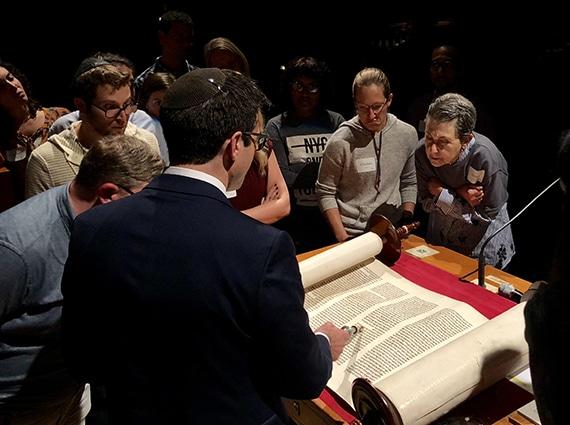
The converts tended to value the feeling of welcome and acceptance within Jewish communities, which was particularly significant for LGBTQ+ participants and others who had experienced marginalization. These converts also found themselves having difficult conversations with family members, questions surrounding Israel and the war in Gaza, concerns about acceptance within the broader Jewish world, and anxieties about whether they would be viewed as fully Jewish. But Liederman finds that they didn’t regret their decisions to convert. While these converts unequivocally supported Israel’s right to exist, many also said they were troubled about the humanitarian toll of the war in Gaza.
For more on this study
Anti-Muslim sentiment is stronger than at any point in the recent past, with politics driving much of this rise in prejudice through 2026, according to data from the Center for the Study of Organized Hate (CSOH). Last April, CSOH documented how 89 elected officials assembled a coordinated anti-Muslim campaign over 13 months, publishing 1,111 social media posts, introducing eight bills, and forming a Sharia-Free America Caucus that grew to 65 members. These campaigns draw on theories about Muslim religious practices, mosques, and the supposed imposition of “Sharia law,” “all reinforcing a broader narrative of an impending Muslim takeover.” These narratives and sentiments have “escalated in successive waves. Abdul El-Sayed’s victory in Michigan’s Democratic Senate primary on August 4 produced the most concentrated wave of the summer. In the seven days that followed, posts targeting El-Sayed with anti-Muslim prejudice rose to 20 times their pre-primary rate, while overall anti-Muslim posts on X reached their highest single-day total since June 1,” according to the center’s report.
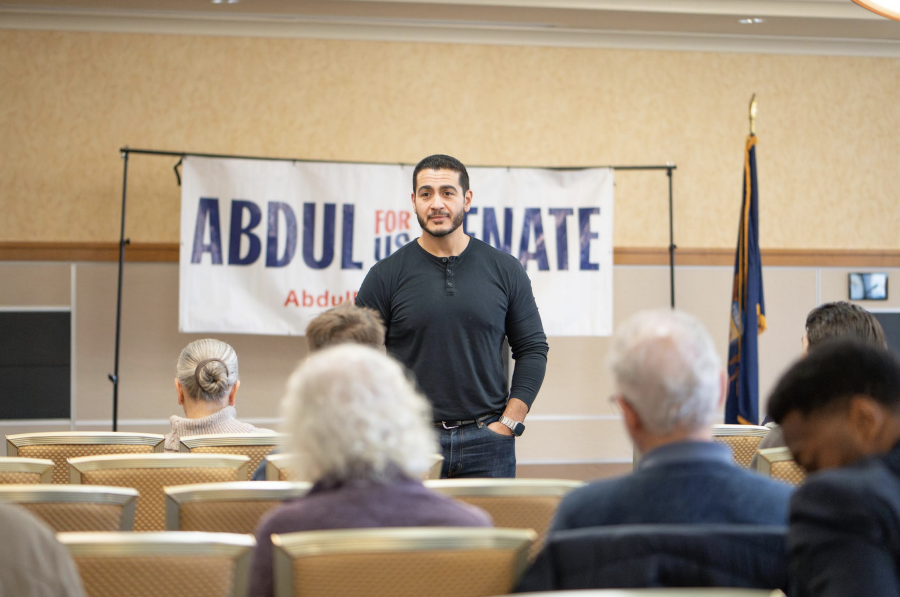
Anti-Muslim posts naming El-Sayed averaged 155 a day between June 1 and August 3. Between August 4 and 10 they averaged 3,099 a day, an increase of 2,944. The 21,690 posts recorded between August 4 and 10 accounted for 56.7 percent of all 38,280 anti-Islamic posts targeting El-Sayed since January 1. The content of the posts revolved around allegations of terrorism and El-Sayed’s connections to Hamas, Hezbollah and the Muslim Brotherhood, often describing him as “an Islamic jihadist.” The content also included El-Sayed’s alleged dual loyalty to America and Islam and that he plans to impose Islamic law (sharia), leading to an Islamic takeover. Remigration of Muslims and banning Islam in the U.S. were also common themes. CSOH observed a closely similar pattern during New York City’s Democratic mayoral elections last year, when Zohran Mamdani’s candidacy drew the same combination of terrorism allegations, Sharia-takeover claims, and dual-loyalty framing. The report concludes that these patterns of anti-Muslim sentiment “are likely to intensify as the 2026 midterm election campaign progresses.”
For more on this analysis
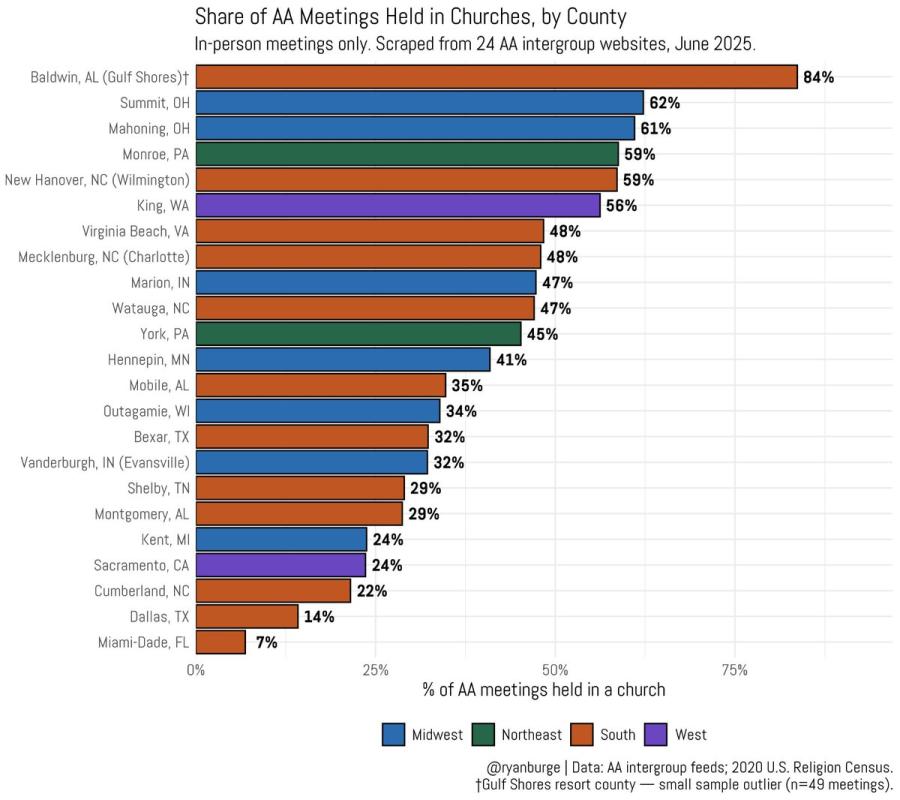
About one-third of Alcoholics Anonymous (AA) meetings take place in houses of worship, but they tend to be in areas with a large mainline Protestant presence, writes Ryan Burge in his newsletter Graphs about Religion (August 3). Scraping data from websites along with the 2020 Religion Census, Burge finds that in general the connection between AA and meetings in churches is “largely idiosyncratic, probably based on some relationships that existed decades ago between AA organizers and local religious leaders and that has just carried on throughout the years.” But he does find that the counties that have the highest share of church-based AA meetings had the lowest share of evangelicals in the local area (although his data set does not include either coast). While church-based AA meetings were less common in deeply evangelical counties, if a county had a greater share of mainline Protestants it likely had a higher percentage of Alcoholics Anonymous meetings being held in churches, synagogues, or mosques. It may be the case that evangelical churches tend to be “larger, programmatic institutions with controlled access to their facilities, whereas mainline congregations often have underutilized fellowship halls and a long tradition of opening their doors to community groups.”
The difference also points to theological differences, with mainline Protestantism historically emphasizing social gospel work and community service while evangelicals focus on evangelism and personal devotion. Burge adds that “The infrastructure of secular recovery in evangelical areas may simply be more developed. Cities like Dallas and Miami have large networks of AA clubhouses—member-owned secular spaces built specifically for recovery meetings—which emerged precisely because church space wasn’t as readily available. The absence of AA in churches doesn’t necessarily mean less AA; it may mean the recovery community built its own parallel infrastructure.” Burge has his doubts about whether it may be possible for the AA community to move its meetings to these other gathering spaces in the face of rapid mainline decline.
Canadians raised by atheist parents are now the least likely of any cohort to “switch” their worldviews during their lifetimes, according to a recent book by veteran Canadian sociologist of religion, Reginald Bibby.The Vancouver Sun (August 7) cites Bibby’s book, The Canadian Transformation: Social Trends 1975 to 2025, as showing that only 1 in 10 Canadians have switched from a non-religious upbringing to becoming “religious.” Bibby finds that 25 percent of adults are now atheists and 15 percent are agnostics—a massive shift from when Bibby first asked Canadians in 1975 if they believed in God. Back then more than 83 percent said they did. The proportion who believes in God, or a higher power, has now dropped to about half, reports journalist Douglas Todd. “In the late 1980s, when I began writing about religion and ethics for The Vancouver Sun,” he adds, “only 16 percent of Canadians said they ‘never’ attended a religious service. By last year the figure had soared to 54 percent.”
In trying to answer why institutional religion has declined so fast in Canada, Todd cites the statistics in Bibby’s book showing that, whereas in 1975 one in four parents “never” had their children take part in Sunday school or other “religious instructions,” that proportion had mushroomed to three in four by 2025. Bibby concludes that “Religious beliefs, like all ideas, require social sources to be instilled and maintained. The obvious idea is that if all Canadians of all ages are decreasingly involved in religious groups, beliefs are going to decrease accordingly.” Yet Bibby also sees signs of religious interest if not vitality: 7 in 10 Canadians continue to believe in near-death experiences, and one in two are convinced of life after death. Even though the numbers are down, almost half of Canadians believe in extrasensory perception and that a person can have contact with the spirit world. Bibby also found that 81 percent still think about the purpose of life.
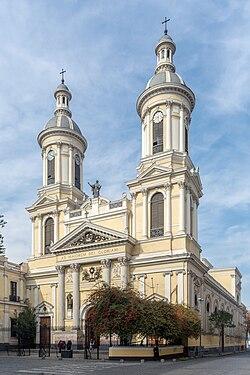
Disaffiliation is not unbelief in Chile, where 51 percent of people aged 18 to 34 no longer identify with a religion, compared with 19 percent in 2006, but 55 percent of these unaffiliated individuals still believe in God and 67 percent say they have their own way of connecting with Him. The statistical data is summarized in an article by Arturo Galarce in the newspaper El Pais (August 22), data that was collected over the past two years through the 2024 census and the Encuesta Bicentenario (Bicentennial Survey) of the Pontifical Catholic University of Chile. Only a third of those between 18 and 34 now identify as Catholic, while 19 percent identify as Protestant in this age group (and 17 percent of the total population do so, with a more stable percentage than the Catholics over the past 20 years). According to Maureen Neckelmann, a sociologist with the Interdisciplinary Program in Religious Studies at the Pontifical Catholic University, people—and young people in particular—are cultivating individualized spiritual forms. She explains that the decisive change concerns authority over belief, with what was once followed as doctrine turning into a path chosen by the individual.
She suggests that what may look inconsistent from outside has an individual consistency: asked about their beliefs, people will construct a coherent account combining different elements. The article also quotes René Gallardo and Rodrigo Navarrete (Institute of Psychology at the Universidad Austral de Chile), who have conducted research on holistic therapists in the south. They identified a search for fulfilment, an emphasis on empowerment, and wariness towards institutions, with each individual responsible for his own well-being. They label as therapeutic spiritualities those practices which combine a spiritual explanation with techniques aimed at relieving physical or emotional difficulties.
(Results of the 2025 Bicentennial Survey about religion. The most recent article by Gallardo-Vergara and Navarrete-Saavedra is “Holistic spiritual therapists in Chilean Patagonia: Seeking alternatives to traditional religiosity and conventional medicine,” Journal for the Study of Spirituality, 2026—first online June 9)
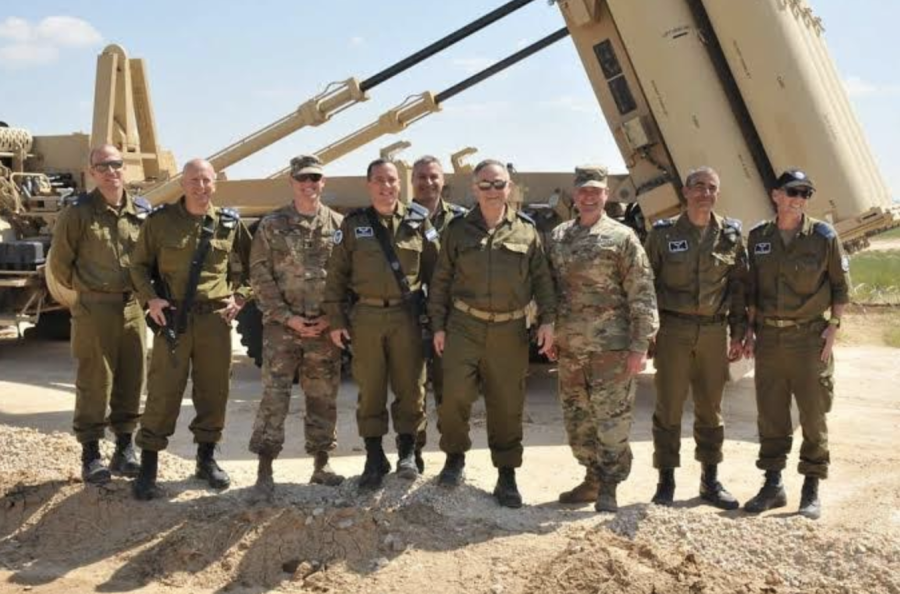
Israeli military operations are increasingly named for biblical and sacred events and themes, especially those conflicts involving Palestinians and other external enemies, according to Vurul Kaptan of the University of Heidelberg. In a paper presented at the annual meeting of the American Sociological Association, which met in New York in early August and was attended by RW, Kaptan studied 158 Israeli military operations from 1948 to 2025. He found that one-third of IDF operations have sacred or biblical names, such as “Gideon.” Kaptan found that the most biblical and sacred names were used in the founding years, from 1948–1969. Then the names of operations took on a more secular nature during the years of occupation, from 1969 to 1999. The post-Oslo accord years, from 2000 to the present, have shown a revival of the use of biblical and sacred names, such as the “War of Revival” for the present conflict with Hamas. That both the founding and the post-Oslo periods more frequently saw biblical and sacred names culturally appropriated or repurposed, usually for contested operations involving other states to give them greater legitimacy, which was not necessary during intra-state conflicts during the occupation, Kaptan argues.