

CURRENT RESEARCH
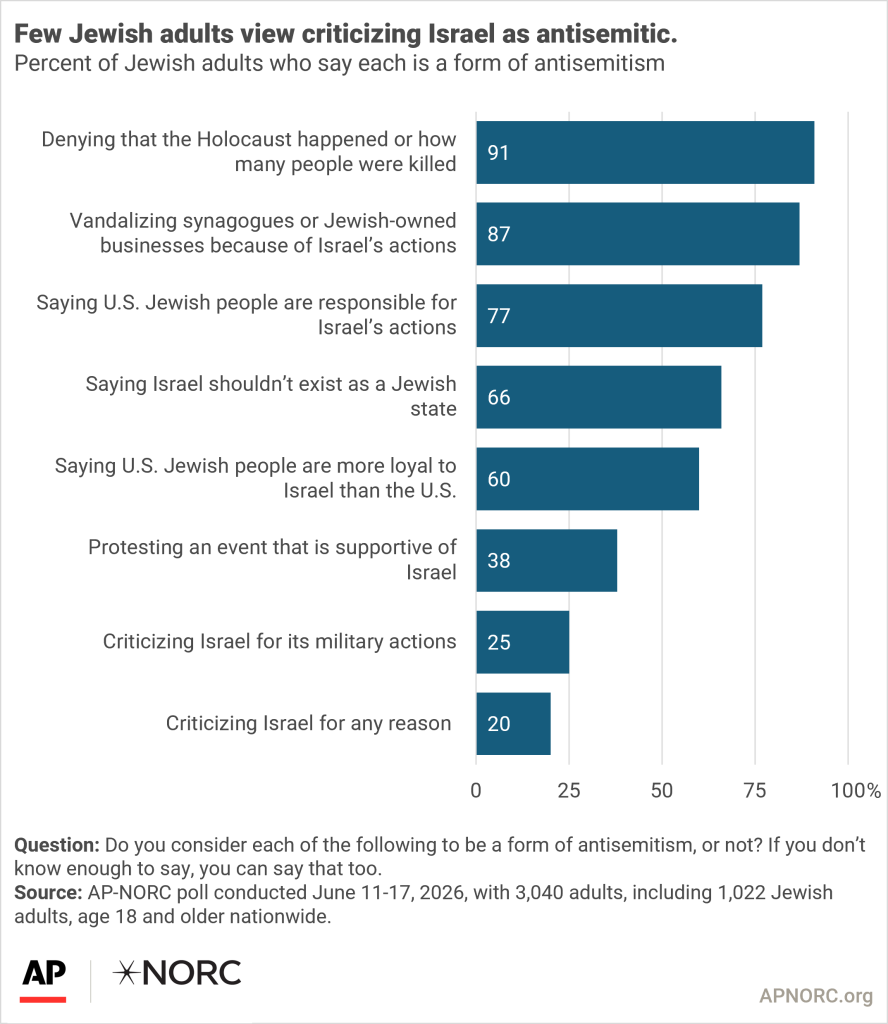
Many Jewish Americans feel unsafe, with a majority saying they feel less safe than they did before October 7, 2023, according to an AP-NORC survey. About 6 in 10 Jewish adults say they feel “less safe” as a Jewish person in the U.S. than they did before Hamas’s 2023 attack, with about 7 in 10 of those who are religiously Jewish saying this. As more Americans have become critical of Israel and its close alliance with the U.S. after the war in Gaza, Jews have felt more vulnerable from antisemitic attacks, including violent incidents. A significant share of Jewish adults, about 3 in 10, say they or someone in their household has experienced physical assault, verbal abuse, online harassment or damaged property because of their Jewish background over the last year, according to the survey. The survey found that about 6 in 10 Jewish adults say that prejudice against Jewish people is an “extremely” or “very” serious problem in the country, a rate that increased if the respondent said they are “extremely” or “very” emotionally attached to Israel. About 4 in 10 respondents are more wary about displaying something that would identify them as Jewish.
Seventh-day Adventists (SDA) in the U.S. have a split identity when it comes to politics and are widely dispersed across the country, even though they are not concentrated in any one part. Those are a few of the patterns Ryan Burge finds in an analysis of the SDA in his series on American denominations in his newsletter Graphs About Religion (July 9). With roughly 1.3 million Seventh-day Adventists in the United States, Burge finds that 57 percent of all counties have an SDA congregation, which means it has a strong geographic spread. The SDA is a “high engagement” type of group, with almost half of the denomination saying that they attend services on a weekly basis, which is at the exact level of the Southern Baptists. The SDA are about the size of a mainline denomination, but they are more ethnically diverse. Slightly less than half of SDAs are white, though in the Cooperative Election Survey sample it is 68 percent white.
They also have a strong contingent of African –Americans, making up 29 percent of the denomination—twice the national average. Additionally, 14 percent of the SDA is Hispanic. SDAs are almost perfectly divided on politics: 46 percent of them lean toward the Democrats and 42 percent lean toward the Republicans, while the remaining 12 percent say that they are politically independent. Burge finds that these political differences suggest a significant racial divide. Among non-white SDAs, two-thirds align with the Democratic party (with 39 percent saying they are strong Democrats), with only 19 percent saying they are Republicans and the rest being politically independent. Among white SDAs, 63 percent are Republicans, and 23 percent are Democrats. Burge concludes that SDAs are a uniquely nearly even mix of conservative leaning evangelicals and left leaning black Protestants. “It’s like two traditions merged together and somehow have managed to get along.”

A study of Arab Muslim trends from 2010 to 2022 finds their religiosity rebounding from declines before the pandemic, but also increasing polarization and more consistent support of Islamist or political Islam positions. The study, published in the International Journal of Comparative Sociology (67:3) and conducted by Arman Azedi (American University), used survey data from 11 Arab countries, finding mixed results as for religious vitality among Arab Muslims, but no uniform path toward secularization. The mid 2010s were marked by growing religious decline, fed in part by the negative reaction to the Islamic State across the region. These declines were stronger among the young and men, while older Arabs and women showed stability. During the Covid pandemic, there was a notable rebound in religiosity. In every country where data was available, the average level of religiosity increased significantly across all demographics.

But this sharp upturn ended post-Covid, with declines resuming and becoming more comprehensive among all demographic groups. Yet these drops in religiosity were not as drastic as during the 2010s, although that may be a temporary effect in the post-pandemic period. Greater polarization has also taken shape in recent years, with the “number of secular, non-religious Arabs [growing] alongside an expanding group of highly religious Arabs. The shifting patterns of decline and growth in religiosity don’t track with the support for political Islam in these countries. Several countries saw personal religiosity and support for political Islam move in opposite directions (with Libya showing a decline in the former and increase in the latter, while Egypt, Iraq, and Tunisia showed decreasing support for political Islam and polarization in religiosity).
International Journal of Comparative Sociology
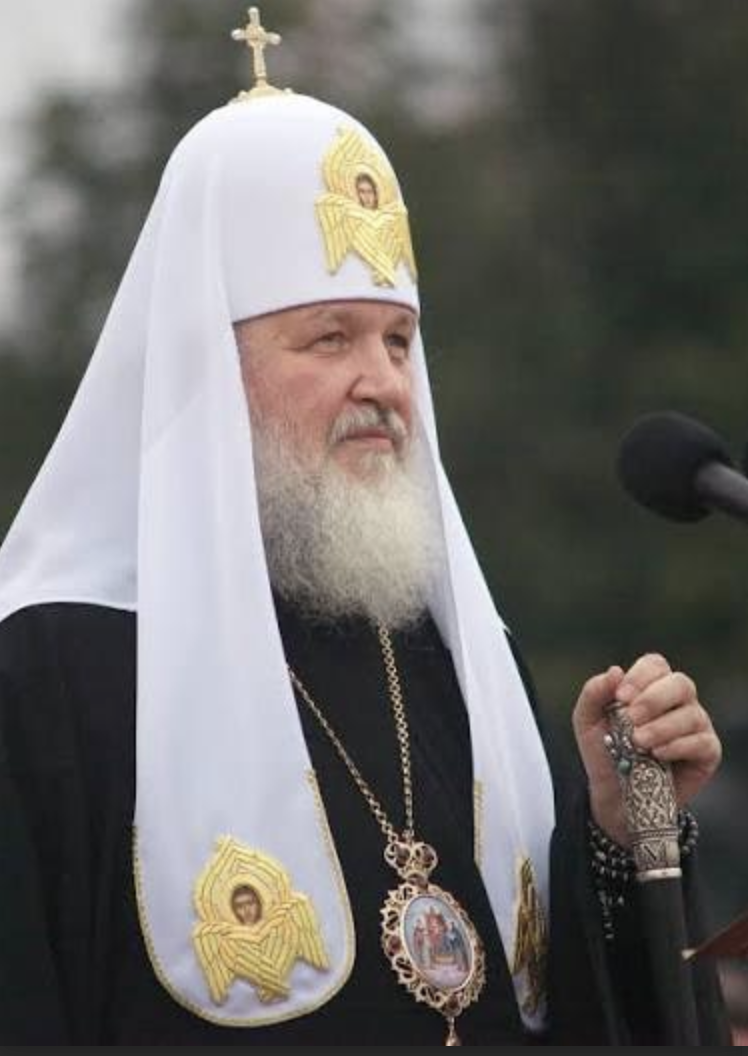
The Moscow Patriarchate’s future depends far less on Putin’s own fate than on that of Putinism—the ideological agenda the church helped to co-create, writes Alicja Curanović (University of Warsaw) in the journal Problems of Post-Communism (June 29). She adds that the church’s options flow from its utility to the ruling elite as a legitimacy provider and promoter of state-sanctioned discourse. That utility has grown as the Kremlin’s ideological message—patriotic statism, civilizational exceptionalism, cultural conservatism, and anti-Westernism—gained coherence after 2012 and hardened during the war. Yet the Patriarchate is no mere transmission belt—it pushed traditional-values discourse and the defense of Middle Eastern Christians onto the Kremlin’s agenda before these became official themes, acting as an ideological entrepreneur in an “asymmetrical symbiosis” (to cite political scientist Juliette Faure). Its persistent advocacy of an abortion ban, despite weak public support and official reluctance, illustrates the point. Three conditions frame Curanović’s forecast. First, a habitus combining the Byzantine ideal of symphonia with an imperial reflex inherited from tsarist and Soviet service—producing a church that aligns with rulers, seeks state patronage rather than grassroots support when weakened, and adapts with remarkable resilience. Second, a partnership in which the state holds structural superiority but has not subordinated the church outright; bishops, former insiders testify, seek closer ties rather than being coerced. Third, an internal consolidation built by Kirill since 2009 that the 2022 invasion did not crack, with dissent being managed through reassignment and defrocking. The war binds Kirill’s fate to Putinism. Unlike in 2008 or 2014, the church endorsed the invasion unequivocally—partly because the 2019 creation of the Orthodox Church of Ukraine had crossed a red line.
Curanović proposes a two-scenario model. Under the “continuator” model, a successor preserves at least the symbolic ideological legacy; the church’s position is secure and may even strengthen if hawks needing allies take power. Under the “challenger” model, the successor builds legitimacy through rupture, and two variables become decisive: whether the war was settled before the transition, and which strategy toward the past is adopted. An unsettled or lost war favors “settling accounts”—lustration, rapprochement with the West—leaving the ROC vulnerable. Punishing it would be cheap and symbolically potent, and such pressure might include removing compromised pro-war hierarchs, even the patriarch, or recognizing Ukrainian autocephaly. No social mobilization would defend it. But delegalization remains unlikely—the church would survive as an ordinary religious institution and would still prefer cooperation to confrontation. The milder “let's move on” variant would allow a low-profile posture and the return of exiled priests. The church would be a bystander in any succession struggle, except in the case of a coup against Putin conducted in the name of Putinism, which could generate real internal division. Continuator outcomes, Curanović concludes, remain the most probable.
In an interview with Sixtine Chartier, published in the French weekly La Vie (July 21), sociologist Isabelle Jonveaux (University of Fribourg, Switzerland) presents a quantitative assessment of monastery closures in France, concluding that roughly a third of contemplative Catholic monasteries have disappeared in twenty years and that the pace of closures has markedly accelerated since the late 2010s. The figures come from a study to be published by an English-language urban planning journal on the reuse of former religious buildings. Since no independent statistical survey existed, Jonveaux took as her baseline a 2007 catalogue of the Fondation des monastères, restricting her sample to Catholic contemplative houses (those defined by enclosure, as distinct from apostolic congregations, which are also affected but fall outside the study). The research established which of these communities still existed in 2026 and which had closed or announced closure. Of the 305 monasteries listed in 2007—consisting of 249 female and 56 male monasteries-- 91 have closed (79 women's houses and 12 men's). Women's communities are proportionally harder hit: 32 per cent have closed, against 21 per cent of men's. Jonveaux attributes this to a deeper crisis in female religious life, which no longer matches the profile of today's candidates.

Where the convent once offered women access to education and an escape from patriarchal authority, women now entering in Europe are typically in their thirties, educated and independent. By order, the Carmelites are the most affected (40 per cent, or 34 of 85 houses), followed closely by the Poor Clares (around 40 per cent), the Trappists (36.4 per cent), the Visitandines (30 per cent) and the Cistercians (25 per cent). Benedictine men and women together stand at about 18 per cent, and Dominican nuns at under 8 per cent. Jonveaux suggests that orders with severe enclosure recruit least easily. But there is an apparent paradox: some of the communities attracting the youngest entrants also practice strict enclosure. Their appeal, she argues, lies in an unambiguous position towards society — the monastery conceived as a fortress against secularization. Liturgical language points the same way, though that it is only one factor among several: of monasteries using French in the office in 2007, 34 per cent have closed; the figure falls to 19 per cent for those combining French and Latin, and to zero for the 23 houses using Latin exclusively.
In a lengthy comment on the study, the publication Nuntiatoria (July 24) notes, “Twenty-three houses are not enough to establish a universal law,” while adding that this is an important finding to be brought into relation with “a whole understanding of the monastery as something received rather than invented by its present occupants.” Jonveaux observes that the emerging model is itself paradoxical — communities claiming rupture with the world, strict orthopraxy and enclosure, while being highly visible online and technologically adept, meeting the expectations of a young public asserting a Catholic identity. In roughly half the recorded cases, the closed community merges with another house of the same order; in the rest it is dispersed, sometimes to nursing homes, and some members return to lay life. Of 47 identified buildings, slightly over a quarter were taken over by another religious community, frequently a newer foundation. Until 2015 France generally saw fewer than four closures a year, while the average is now close to ten. France's exceptionally dense monastic landscape, comparable to Italy's, means supply far exceeds demand. Public enthusiasm for monastic retreats — fueled by influencers and a romanticized image of ecological, traditional living — does not translate into vocations.