

CURRENT RESEARCH

Radical human enhancements, such as genetic treatments for improving and changing inborn traits, face the strongest opposition from church-attending conservative Protestants and receive the most support from atheists and agnostics, according to the first-ever survey on the U.S. religious public’s views on the issue. The survey was conducted by John H. Evans and published in the Journal for the Scientific Study of Religion (online in May). Radical human enhancement goes beyond making changes that may make a human more like other humans (such as in IQ) and moves into the territory of transhumanism, encouraging humanity to transcend our currently limited bodies and achieve traits humans never had before. Using a nationally representative survey, Evans finds that active conservative Protestants were most opposed to such technology, followed by Catholics and then by religiously indifferent and low-attending and liberal Protestants and Catholics. The atheists and agnostics were found to be much more supportive of such measures. Evans argues that opposition or support for secular ideologies such as scientism, the view that science should be the source of one’s values and ethics, were more influential than religious views, such as theological teachings on God’s design for the world. Atheists and agnostics have been found to be more likely to elevate the role of science to the level of religious commitment, he added.
Religion has become an important factor in the degree and kind of neighborliness Americans show, even as this characteristic is on the decline in the country as a whole, according to the American Neighbor Survey. The survey, conducted by Daniel Cox, Jae Grace, and Avery Shields, explores the various ways in which Americans are—and are not—interacting with the people in their immediate communities. They note that in the past decade the frequency of neighborly interactions has plummeted, especially among young adults, even though Americans have been spending more and more time in their own neighborhoods. The survey finds that only 40 percent of Americans report talking to their neighbors regularly (at least a few times a week), with 17 percent saying they did not talk to their neighbors at all. This is a decline from 2012, when nearly 6 in 10 Americans (59 percent) said they talked to their neighbors at least a few times a week. The evidence for a religious gap is noteworthy, particularly when it comes to congregational attendance. Those who attend religious services frequently are much more socially active in their neighborhoods than are those who infrequently or never participate in religious services.
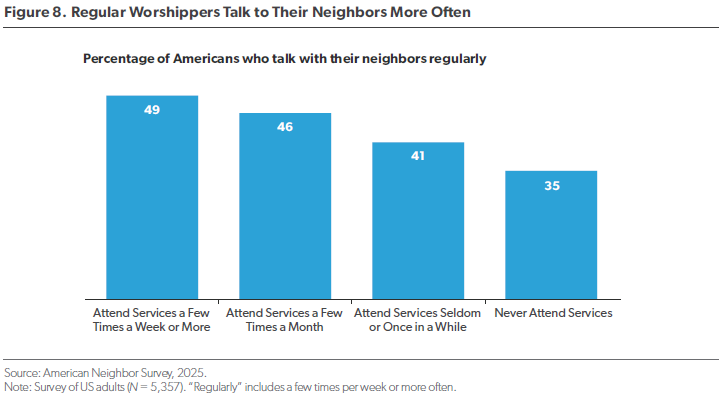
Americans who regularly attend religious services have stronger social connections with their neighbors and are more likely to work with them to address community problems and concerns, according to the researchers. They also interact with their communities differently and have a different conception of neighborliness than infrequent or non-attenders. Only about half (52 percent) of Americans who attend services more than once a week say keeping your distance from others is what makes a good neighbor, compared to nearly three-quarters (73 percent) of those who never attend services. Over 4 in 10 (43 percent) frequent attendees say they spent a social evening with a neighbor at least several times a year, compared with 32 percent of those who seldom or never attend. Among regular attendees, nearly 3 in 10 report working with people from their neighborhood to fix a problem annually or more often, compared to 16 percent of infrequent and non-attenders. As for the significance of affiliation itself, religious Americans are more likely than their nonreligious counterparts to prioritize living near their extended family: 57 percent of religious respondents say this is important, compared to 41 percent of non-affiliated Americans or nones. Religious Americans are much more likely than their none counterparts to say living in a community with traditional values is important (71 percent compared to 40 percent). They also tend to prioritize living in places with a strong sense of community, whereas secular Americans care more about having a diverse community.
A growing minority of Americans say religion is gaining influence in American life, with more than 50 percent of this group saying religion plays a positive role in society, according to a survey by the Pew Research Center. Today, 61 percent of U.S. adults say religion is losing influence in American life, while 37 percent say it is gaining influence. The share saying religion is gaining influence has grown by 19 percent in the last two years and is now as high as it has ever been in Pew surveys dating back to 2002. Of Americans expressing a positive view of religion’s role in American life, 21 percent say that religion’s influence is growing and that this is a good thing, and 34 percent agree that its influence is declining and this is a bad thing.
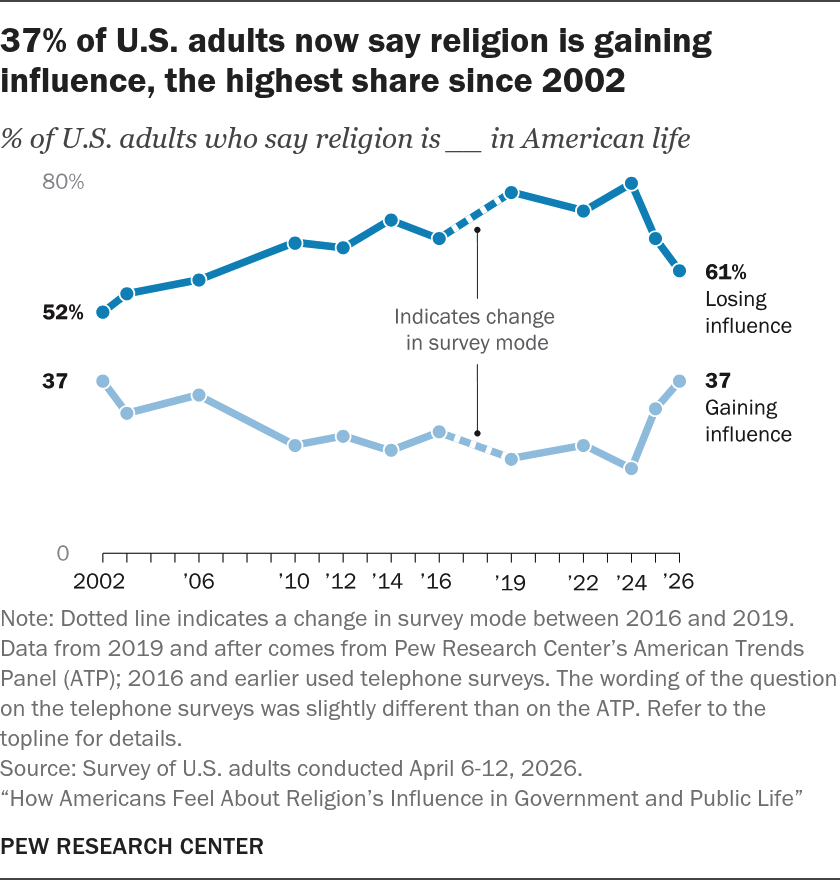
The survey also finds growing familiarity with the term “Christian nationalism,” although attitudes about the diffuse movement are largely unchanged from recent years. For example, there has been no growth in the shares of Americans who want the government to stop enforcing church-state separation or who believe that God favors the United States over all other countries. There has been a small uptick in the share of U.S. adults who say the federal government should declare Christianity the nation’s official religion (17 percent today compared with 13 percent in 2024). At the same time, most people want churches and other houses of worship to stay out of day-to-day politics and not endorse candidates. A sharp partisan divide continues between Republicans and Democrats, with the former more likely to say religion has a positive influence on American life.
Continuing his series on denominational trends in his newsletter Graphs about Religion (May 28), Ryan Burge writes that Unitarian-Universalism (UU) is facing a “shrinking membership, fewer congregations, and an increasingly narrow geographic and demographic footprint.” Burge, analyzing the denomination’s annual Certification Report data as well as numbers from the Census Bureau, finds that many of the key trends facing the UU look “strikingly like what’s happening with the Episcopalians or the United Methodists.” He notes that, unlike most denominations which only count formal members, the Unitarian-Universalist Association (UUA) tracks two distinct groups: dues-paying members who have officially joined a congregation, and “non-member friends” who regularly participate and financially support a congregation but haven’t formally become members. Burge writes that both groups are declining. In 2016, the UU counted a total membership of just over 151,000, with the “friends” adding another 99,000 to that total. Membership held somewhat steady between 2016 and 2020, declining by just 7,000. But the “friends” dropped by almost a third during that same time period (from 99,000 to just 64,000). More recently, however, “both metrics have continued to slide. In 2025, membership is down to 130,000 and non-member friends are at 54,000. In other words, there are 66,000 fewer Unitarians today than just a decade ago. That’s a drop of just over 26 percent,” Burge writes. But there are sharp differences between UU membership figures: while the Religion Census counted UU as having just over 201,000 members a few years ago, a population-based sampling study from Public Religion Research Group pIaces them at 1.5 to 2 million members.
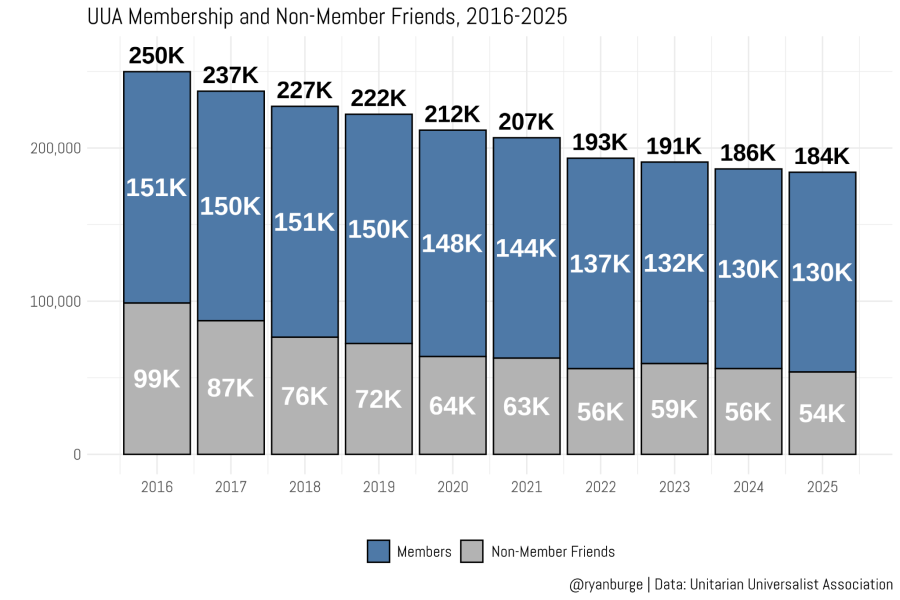
This discrepancy may have to do with “the sneaking suspicion that a whole bunch of Americans like the idea of Unitarianism but just can’t or don’t want to join a congregation,” Burge writes. As for congregation size and the distribution of members, he finds that the majority of UU churches have no more than 100 members. The share of UU congregations that have more than 250 members is just 14 percent; there are only about 150 “large” Unitarian fellowships in the entire U.S. The UUA is similar to the United Church of Christ in terms of a large share of very small churches. Among other findings, 61 percent of Unitarian Universalists live in very highly educated counties; as far as politics, almost half of UU congregations (44 percent) are found in blue-leaning counties, but almost none are in deeply red places. As for finances, even though membership and the number of individuals and families pledging to congregations both dropped in the last decade, the average value of pledges has risen during that time (from $1,492 back in 2015 to $2,134 in 2025). The declining number of givers is also offset by the rising number of endowments held by Unitarians and related foundations (to the score of $791 million), while liabilities and debts are decreasing. This financial pattern is similar to that of the Episcopalians, putting both denominations in the same dilemma in about 30 years: “a bunch of money but not a bunch of people.”
Higher exposure to religious pluralism in a couple’s social networks is associated with a decreased likelihood of baptism, according to a Swedish study published in the Journal for the Scientific Study of Religion (online in May).
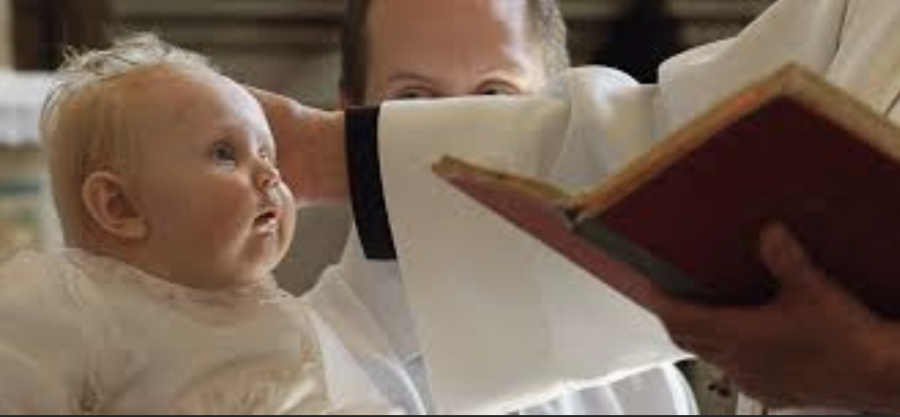
The study, by Elis Carlberg Larsson, takes a social network rather than a society-level approach to the long-time question of how pluralism affects religious commitment. Larsson analyzed Swedish register data containing longitudinal demographic and socioeconomic information on all children born in Sweden between 2002 and 2022, which includes whether individuals were Church of Sweden members and paid the church tax. He found that those parents more enmeshed in pluralistic social networks baptized their children at a significantly lower rate, thus likely “undermining the probability of parents transmitting their religious affiliation.” This was especially the case when kinship ties were involved; parents experiencing “religious cross-pressure,” such as when partners had different religious affiliations, were more susceptible to pluralism. When the father is not affiliated with the church, the mother (who is typically the primary driver of religious socialization) may be particularly susceptible to external signals from her network, lacking reinforcement from her partner.
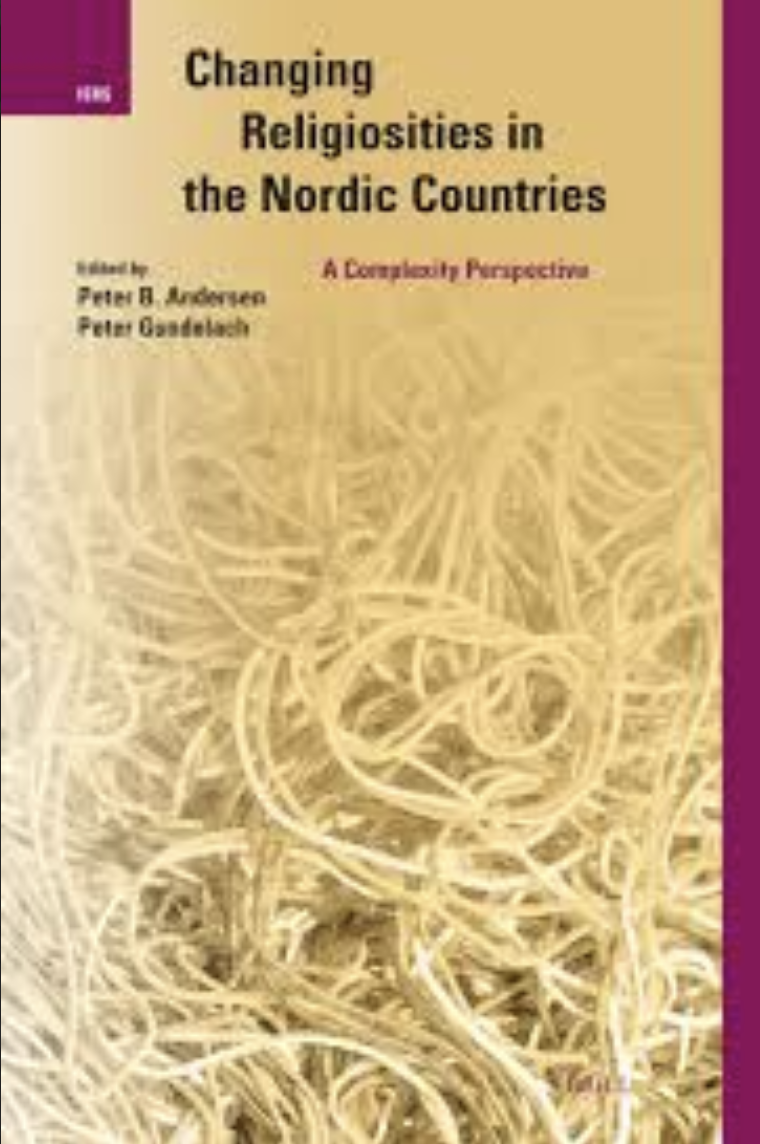
The current religious situation in Scandinavia is marked by rapid secularization, pushing more people outside all religious organizations, together with immigration-driven pluralization. But, despite the widening distance from their populations, the majority churches retain a notable institutional stronghold, write Sille Fusager, Kimmo Ketola, Pål Ketil Botvar and Maria Klingenberg in a chapter of a book edited by Peter B. Andersen and Peter Gundelach (University of Copenhagen), Changing Religiosities in the Nordic Countries: A Complexity Perspective (Brill). The chapter offers a bird’s-eye view of religion across the five Nordic countries (Denmark, Finland, Norway, Sweden, Iceland), combining an analysis of legal structures with demographic statistics. Its organizing theme is the “Nordic paradox,” where some of the world's most secularized societies in belief and practice nevertheless have majorities who remain formally affiliated with the Lutheran churches (from roughly 54 percent in Sweden to 74percent in Denmark in 2021). On the legal side, the dominant trend is gradual disestablishment. The Lutheran churches are still named in all five constitutions, but state executive authority has steadily devolved to the churches themselves. Whereas bishops were state-appointed in all five countries in 1980, today this holds only for Denmark. Sweden (2000), Norway (2017), Finland (1990s–2000) and Iceland (1997) all loosened state ties, leaving Denmark as the country closest to having a genuine state church.
Christofferson’s notion of “by law established” churches is offered as more accurate than “state church.” Funding mechanisms vary, from church taxes (Denmark, Finland, Iceland) to state-collected membership fees (Sweden) and direct budget financing (Norway). The demographic trends are the chapter’s core. First, immigration since the 1980s has driven population growth and rising religious diversity; Sweden has the largest immigrant share (with about 20 percent of the population being foreign-born in 2020), while most immigrants region-wide come from Europe, followed closely by Asia. Second, majority-church membership is declining everywhere, with the decline accelerating after 2000. It has been steepest in Sweden (going from 89 percent in 1990 to 54 percent in 2021) and slowest in Denmark. The fall reflects disaffiliation, lower baptism rates, and the non-Lutheran background of many immigrants. Third, participation in church rites is dropping unevenly. Church weddings have fallen fastest (comprising only 23–40 percent of marriages by 2021); baptisms have declined sharply (ranging from a 35 percent drop in Sweden to a 62 percent drop in Finland); confirmations are falling more gradually with wide cross-country variation; and funerals remain the most resilient rite. Fourth, religious minorities are growing—with Muslims being the largest non-Christian group and Catholics the largest non-Lutheran Christian community—alongside a rising share of the non-affiliated.
(The volume Changing Religiosities in the Nordic Countries: A Complexity Perspective costs €135 but its 14 chapters can be downloaded for free.)
A survey from Russia’s Public Opinion Foundation shows that the proportion of Russians identifying as Orthodox has fallen from 78 percent to 65 percent in the past 15 years. The Pillar (May 15) cites the survey, conducted on behalf of St. Tikhon’s Orthodox University in Moscow, as also finding that the proportion of Orthodox Christians who never attend services has risen from 28 percent to 32 percent in the same period. The new research, based on a survey of 1,501 adults, also looked at Orthodox Communion practices, which tend to be less frequent than for Catholics because of strict fasting and confession practices. The proportion of active Orthodox Christians receiving Communion once a month or more has increased significantly, from 14 percent in 2011 to 45 percent in 2020 and 64 percent in 2026.
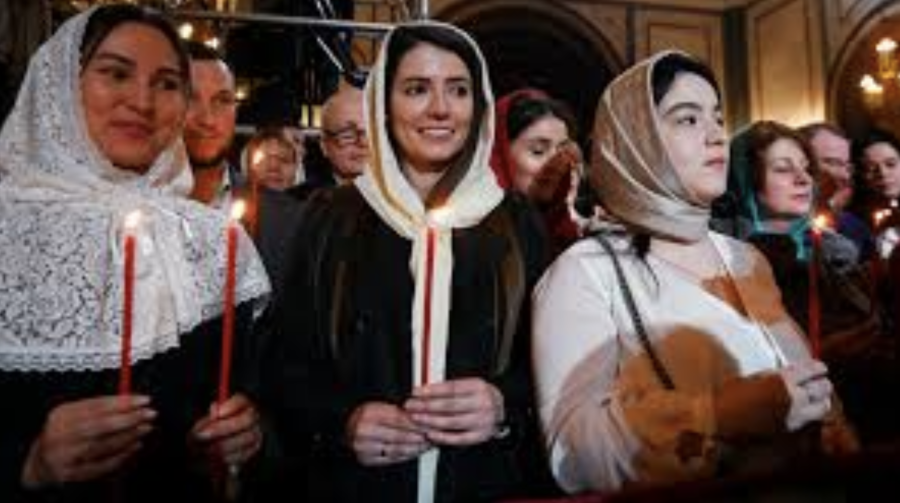
Among Orthodox Christians in Russia as a whole, however, the overall proportion receiving Communion monthly has only risen from 2 percent in 2011 to 5 percent in 2026. Elena Prutskova of the Sociology of Religion Research Laboratory at St. Tikhon’s said that the increase reflected a contrast within Russian Orthodoxy between a highly committed core of believers and a broader group that identifies with the church because it forms part of their ethnic identity. Russian professor Valentina Slobozhnikova added that religiosity in Russia grew strongly in the three decades after the 1991 collapse of the Soviet Union, but the upward climb stopped around 2019. This trend is seen as part of the broader European-wide decline in religious affiliation, particularly among a younger generation taking a more individualistic approach to religion. But she said that active Orthodox Christians were becoming even more committed amid contemporary challenges in Russia, such as the war in Ukraine.
Turkey is undergoing a loss of public religiosity, particularly among men, but private devotion and spirituality are continuing, an extensive study appearing in the current issue of the journal Turkish Studies (April) reports. The study, conducted by Ali Carkoglu, draws on nationally representative surveys from 1990 to 2023, specifically the World Values Survey, International Social Survey Program, and Turkish Election Studies, allowing for longitudinal analysis. Carkoglu identifies three periods of Turkey’s engagement with religious identity, practice, and belief in light of the nation’s politics. In the first period, from 2002 to 2011, there was consolidation, where the infrastructure of mosques expanded along with the authority of the Diyanet (the religious arm of the government), and which was characterized by a broad if shallow religiosity.
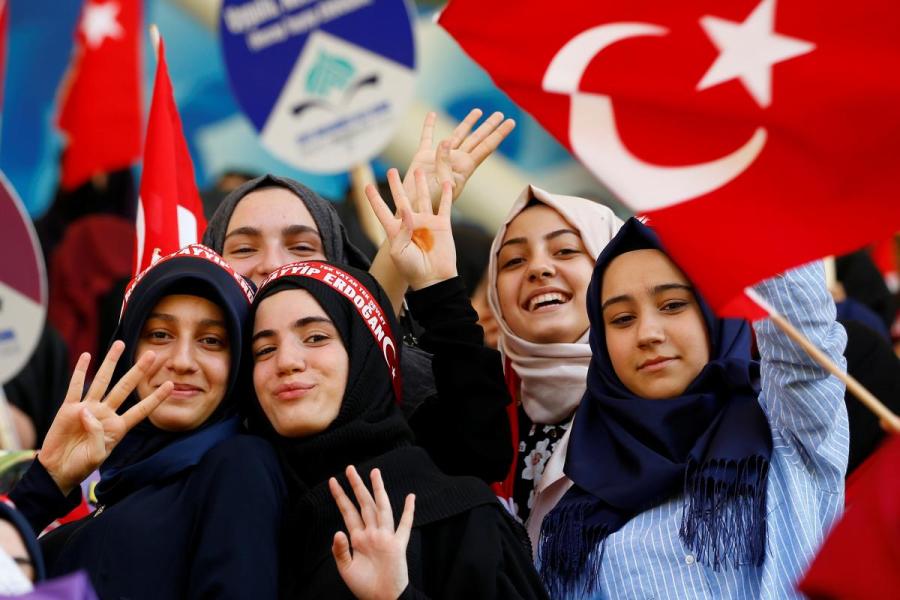
In the second period, from 2011 to 2018, the politicization of religion gained ground as the AKP party fused populism with Sunni Islam. This is where there was some backlash against religion, as seen with Friday-only attendance at mosques among males and the simultaneous retreat of young women from public religious spaces. The third phase, from 2018 to 2023, was shaped by an economic crisis, authoritarianism, and the Covid pandemic, accelerating “the privatization of piety. Declining trust in clergy and religious institutions points to a secularization of authority, while enduring but more doubt-tolerant belief underscores the reflexive individualization of faith,” Carkoglu writes. He concludes that religious change in Turkey may result in a continued decline in religious practice, but also persistent core beliefs and increasing religious diversity that would work against inevitable secularization.