

CURRENT RESEARCH
Five years after the disruptions of Covid-19, most attenders remain consistently engaged or have increased their congregational attendance, with a significant 38 percent of attenders joining their current church after the pandemic began, according to a new study.
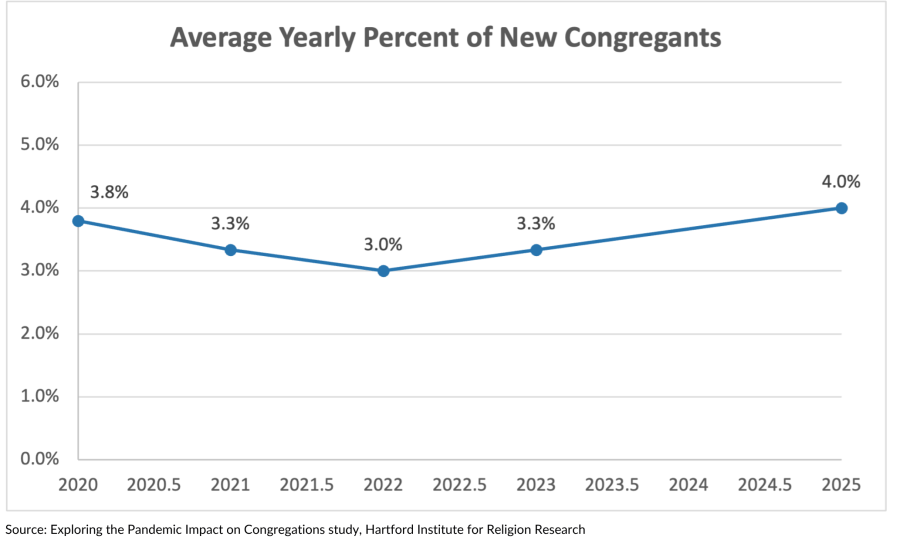
The Exploring the Pandemic Impact on Congregations study analyzed data from a Faith Communities Today (FACT) survey of over 24,000 church attenders from more than 80 different denominations. It is cautiously hopeful about the resilience of congregations since the pandemic. The study found that median in-person worship attendance has risen to 70 persons—surpassing pre-pandemic levels and marking the first positive gain in 25 years of tracking. Median congregational income reached $205,000 in 2025, which is significantly above inflation-adjusted expectations. Congregational participation in volunteering has also rebounded to pre-pandemic levels, with 40 percent of congregants now volunteering regularly. The survey also found 58 percent of congregational leaders saying their congregation is stronger now than before the pandemic. This may be related to the finding that clergy’s well-being has improved across physical, mental, spiritual, relational, and financial dimensions. Online worship is widely offered, but in-person worship remains dominant, with 26 percent of church attenders using online worship regularly.
(This study can be downloaded at: https://www.covidreligionresearch.org/research/national-survey-research/signs-of-rebound-amid-uneven-recovery-the-changing-congregational-landscape/)
While the idea that immigration is good for religion is widespread, examination of the religiosity of immigrants does not reveal great differences between them and native-born Americans, according to an analysis by Ryan Burge in his newsletter Graphs about Religion (April 20). In analyzing the Cooperative Election Study—which has been asking questions about the immigration status of respondents since 2010—Burge finds that among those coming to the United States, 51 percent identify as Protestant or Catholic and 35 percent say that they have no religious affiliation, with the remaining 13 percent scattered across a range of other faiths. In looking at the religious composition of children of immigrants, they follow the same pattern as people who immigrated themselves. But among the second generation of immigrants, there is more movement—the share of Christians goes up to 59 percent (with Protestants sharply rising to 59 percent), but the share of non-religious also increases to 38 percent. The share of white immigrants who are “nones” is 41 percent, while the “share of white folks who have been here for generations who are nones is 37 percent. So, again, bringing in people from majority white countries is not going to make America more religious,” Burge writes. Black immigrants showed lower rates of non-religion than native-born African Americans (26 percent versus 36 percent). But for Hispanics, there is basically no change in the share of nones at all across each type of immigrant. Over time (since 2010), the Protestant and Catholic share of immigrants has slowly been eroding (dropping at least five points for Protestants and three points for Catholics).
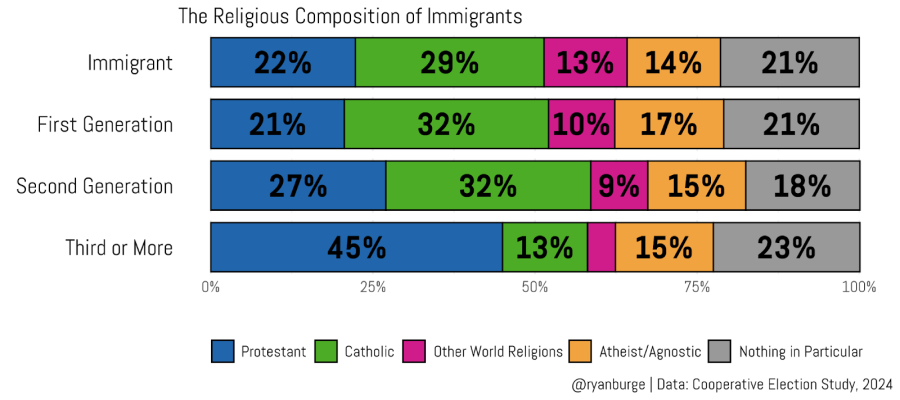
Burge finds that the most noticeable trend is that immigrants to the United States are noticeably more likely to be non-religious now than immigrants in 2010. In 2010, only 5 percent of immigrants to the United States said that they were atheist or agnostic, while another 19 percent said that their religion was “nothing in particular.” In 2024, the share of atheist/agnostic immigrants rose to 12 percent and the nothing-in-particular population rose three percentage points. In comparing Protestants and Catholics for religious change across generations, the more recent arrivals are more likely to be Catholics. The Catholic share among immigrants is noticeably higher than it is among those who have been here for generations (31 compared to 14 percent). For Protestant affiliation, immigrants are 20 percent less likely to be Protestant than those who have been here for generations. Burge finds that only 14 percent of immigrants to the United States come from minority religious groups, which is lower than Catholics and Protestants. He also finds that the rates of the non-religious are similar for recent immigrants and those in the “third generation or more” category (around 12 to 14 percent). The gap also isn’t very large between immigrants and the third-generation group when it comes to church attendance rates. In the most recent data, immigrants are less likely to be in the never/seldom categories of attendance (at 50 percent versus 55 percent among the “third generation or more” group). But weekly attendance rates were a “statistical dead heat” at 25 percent vs 26 percent. On the whole, Burge sees immigrants as only slightly more religious than other Americans. “The data says that immigrants are assimilating in a very important way—they are leaving religion behind. Just like Americans who have been here for generations are doing.”
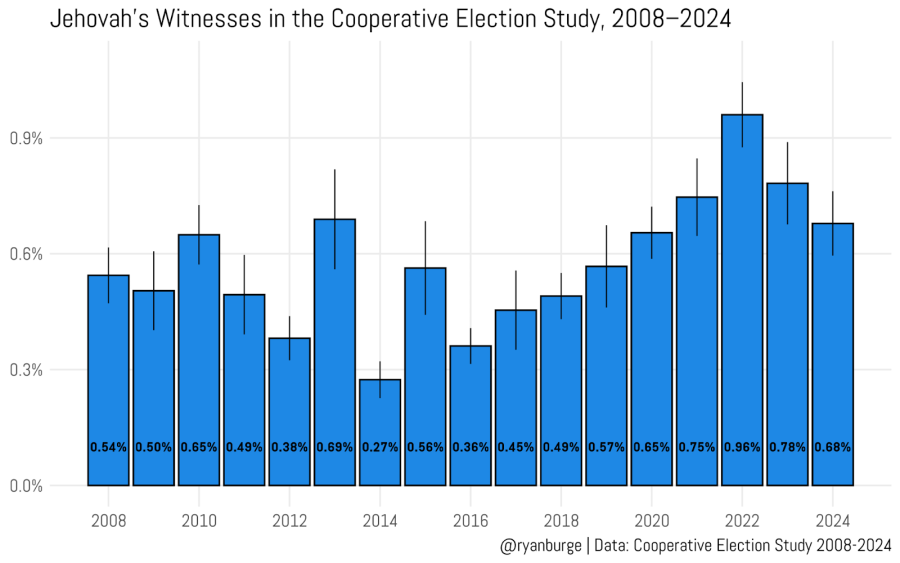
Jehovah’s Witnesses are among the most devoted church members in the U.S, while showing a significant rate of ethnic diversity, according to the Graphs about Religion newsletter (April 9). Editor Ryan Burge analyzes the Cooperative Election Study, which has one of the few datasets with a large enough sample to capture Jehovah’s Witnesses, along with the 2020 Religion Census to estimate that they make up 0.8 percent of the population, roughly totaling between 2.75 and 3 million members. This means that there are more Jehovah’s Witnesses (JWs) in the United States than every Protestant denomination aside from the Southern Baptist Convention, the United Methodist Church, and the Evangelical Lutheran Church in America. There is no regional concentration of JWs, although the Midwest shows a smaller number of members and kingdom halls. The only fairly dense area for the witnesses is New York City [which may be related to the headquarters once being located there and currently being close by]. Burge finds that Jehovah’s Witnesses have a “level of racial heterogeneity that far surpasses that of most Protestant denominations. About one-third of JWs are white and one-third are Black, with another 25 percent Hispanic.”
As for devotion and church attendance, the JWs have a very high 60 percent involvement in one or more weekly services—a level of religious devotion that is higher than that of any other religious group Burge has studied (with only 11 percent of Latter-day Saints attending multiple times per week). But Burge finds that over half of JWs have not moved beyond a high school diploma, which is 19 points higher than the rest of the population. As for politics, most Jehovah’s Witnesses take a neutral approach to these issues, reflecting the official position of the denomination. He concludes that in “every single slice of the survey data, a significant majority of Jehovah’s Witnesses say that they are politically independent. That number rose as high as 65 percent in the most recent survey. So, it does seem like the median position is one of avoidance not engagement. Although, I think we can see some weak evidence that the JWs tend to lean slightly more toward the Democrats than the Republicans. There’s no survey where the GOP share is larger.”
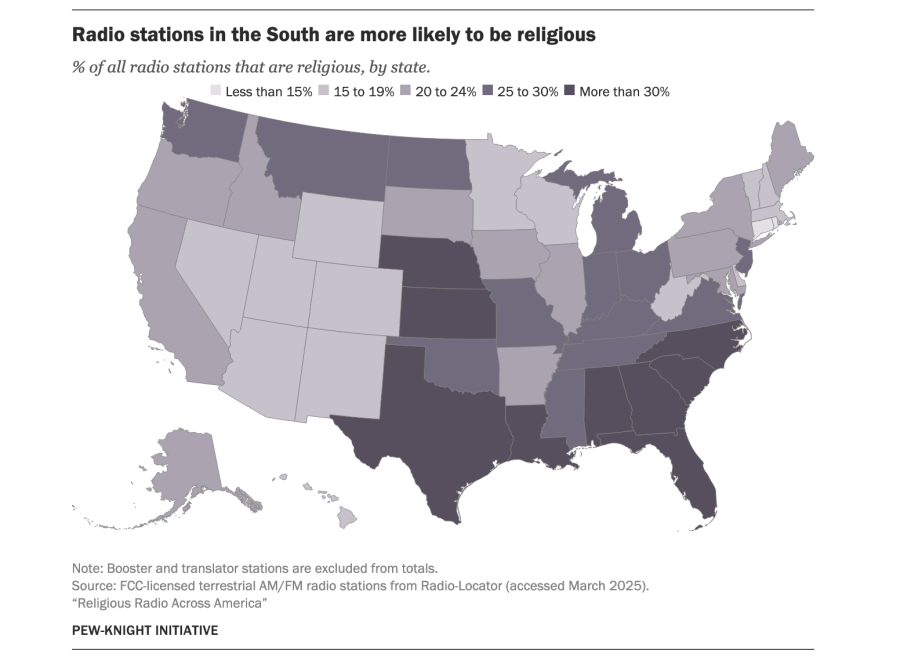
Religious radio stations are widespread and attract a large audience in the U.S., with most stations being in the evangelical Christian camp, according to a study by the Pew Research Center. The study found that 45 percent of U.S. adults say they listen to religious audio programming (including podcasts and streaming services), with about three-quarters of those listeners at least occasionally tuning in on the radio. Seven-in-ten listeners say they get religious programming this way, and nearly all of the most popular radio shows are also available on these radio platforms. These stations tend to spend several hours per day discussing topics like lifestyle and personal development, family and parenting, and health and wellness. The other half of programming time is devoted to a mix of music, religious services and sermons. Specific music artists, mainly from contemporary Christian music, and talk shows dominate half of all religious radio stations.
The top 1 percent of music artists accounted for more than half of all songs played on religious radio in July of 2025.
Although 63 percent of these stations identify as Christian, most are not aligned with a tradition or denomination. It was found that 77 percent of stations see evangelism as their key component. Most stations are part of larger syndicates. Around 3-in-10 religious radio stations in the U.S. are independently owned. The other 72 percent belong to multistation ownership groups of varying sizes, according to the Pew analysis. While most people who listen to religious audio programming do not cite news and politics coverage as a core reason for doing so (just 14 percent do), 40 percent said such coverage is a minor reason they listen. The study found that religious radio stations spend around two hours a day on average discussing politics, current events and social issues. Those stations that discuss politics often tend to cover nearly all these issues in an opinionated way. The more politics-heavy stations tended to take an opinionated stance against such issues as abortion and LGBTQ issues. On these stations, Trump was mentioned in nearly two hours of coverage per day. “That’s 38 minutes more than is spent discussing the economy, the second-most common topic,” the Pew report notes.
(The study can be downloaded at: https://www.pewresearch.org/data-labs/2026/03/26/religious-radio-across-america/)
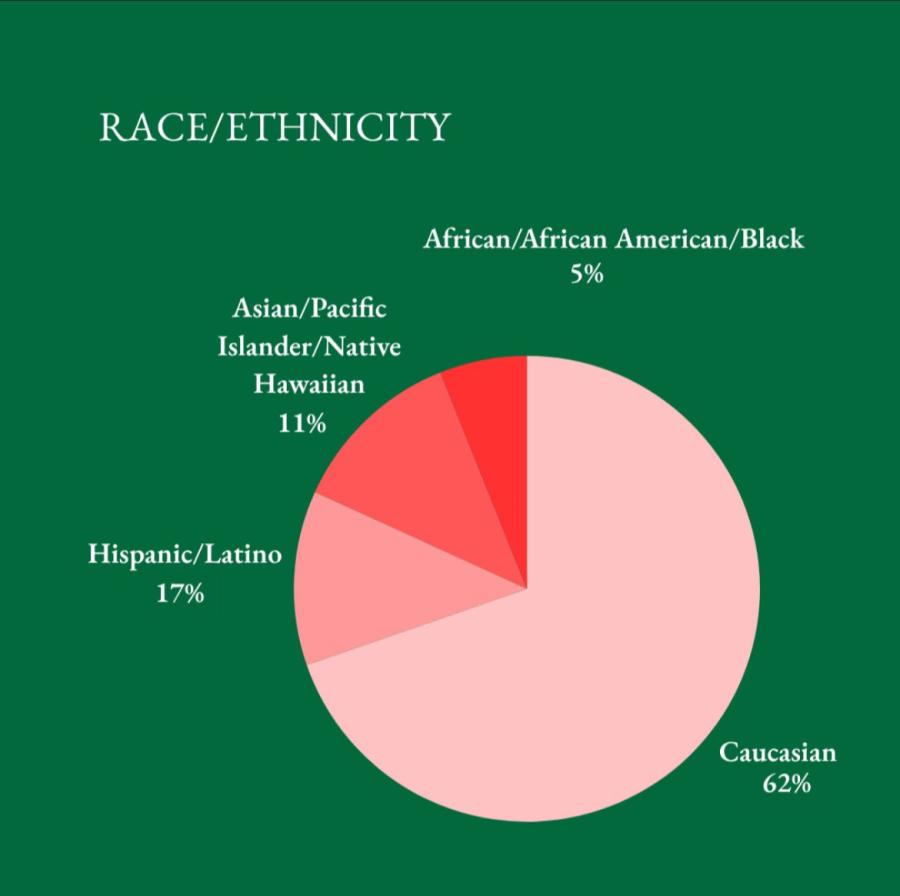
A survey of 400 candidates to the Catholic priesthood reveals both continuity and change in the church, reflecting greater ethnic and educational backgrounds. The survey, conducted by Georgetown University’s Center for Research on the Apostolate and the United States Catholic Conference of Bishops, found that the majority of those preparing for ordination are lifelong Catholics, with the average age being 33. Sixty-two percent of respondents identified as white, while 17 percent identified as Hispanic or Latino, 11 percent as Asian or Pacific Islander, and 5 percent as black or African American. More than a third—35 percent—were born abroad, with most coming from Vietnam, Mexico and Colombia, before immigrating to the United States at an average age of 22.
Educational backgrounds varied widely, with 39 percent completing an undergraduate degree before entering seminary, and 13 percent obtaining graduate-level qualifications. Among those who pursued higher education, theology and philosophy were the most common fields of study, followed by business, engineering and the sciences. Eleven percent reported being home-schooled at some stage of their education. Parish involvement was important in fostering these vocations, with 93 percent saying they had participated in at least one parish ministry before enrolling in seminary, such as altar servers, lectors, youth ministers or catechists. Such devotional practices as participating in Eucharistic adoration (81 percent) and Rosary prayer (79 percent) were common among these candidates. While 92 percent of respondents agreed that they received some encouragement by at least one person, a minority felt discouraged by family members or friends from pursuing the priesthood.
(The study can be downloaded at: https://www.usccb.org/resources/Report-Ordination%20Class%202026-April%2008-FINAL.pdf)
The number of Catholic marriages in Ireland has declined by 51 percent in just 10 years, according to a new study from the Central Statistics Office (CSO), the country’s chief statistical agency. Catholic marriages fell from over 13,000 to 6,425 between 2014 and 2024. Civil ceremonies now outnumber Catholic weddings, with a sharp rise in secular humanist and “New Age” weddings, according to the study. While the Irish population grew substantially in the 10-year period, marriages declined by 7.7 percent overall. Ireland now has one of the lowest marriage rates in Europe at 3.8 per 1,000 people. The Catholic Herald (May 6) notes some caveats to the study. The first is that the statistics include both same-sex and opposite-sex marriages. When same-sex marriages are excluded, the Catholic option remains the most frequently chosen.
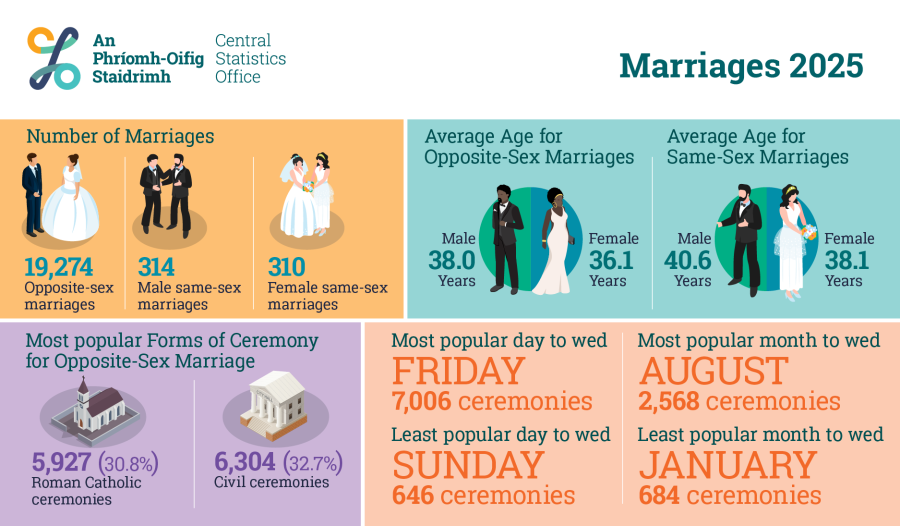
The newspaper adds that the reality of second marriages complicates things because the Catholic Church teaches that such marriages must take place outside the Catholic sphere. Among first marriages, Catholic weddings are still the most popular choice, accounting for 40 percent of marriages in 2024, according to a study by the Christian think tank, the Iona Institute.
The article notes that marriage in Ireland has “been reshaped over the past 30 years by two referendums—national votes to change the country’s constitution—that legalized first divorce (1995) and later same-sex marriage (2015). Both of these practices have significantly undermined the understanding of marriage as a lifelong bond between a man and a woman…” A striking finding of the study is the degree to which “New Age” ceremonies, what the CSO calls “other religious denominations,” have rapidly flourished on the wedding landscape, making up a quarter of all opposite-sex marriages. The Iona Institute found that in 2024, the largest such groups, which may also be considered neo-Pagan, providing these wedding ceremonies were OneSpirit Ireland, Entheos Ireland, the Earth Spiritualist Tradition, One World Ministers and Our Spiritual Earth. The newspaper cites prominent Irish Catholic commentator, Breda O’Brien, who suggests that the decline could be halted to some degree if the church allowed Catholic weddings to take place outside a church setting. She points to a 2024 study on marriage in Ireland conducted by the Iona Institute, which found that for many a secular wedding was chosen as much for convenience as anything else, with hotels offering complete ceremony and reception packages.
(Catholic Herald, https://thecatholicherald.com/article/catholic-weddings-in-ireland-down-by-half-in-10-years)
Spain appears to be following other European countries in seeing a segment of its youth showing greater spiritual interest and identities, according to a new study. The findings were published in the report Young Spaniards 2026 by the SM Foundation, based on a survey of young people aged 15 to 29. The Catholic news service Zenit (April 24) reports that the survey found that young people in Spain increasingly identify as Catholic, seen as reversing decades of secularizing trends. The survey also found that a large majority are disillusioned with democracy. The report comes amidst a flurry of reports of renewed religious interest among younger generations in parts of Western Europe, including reports of record adult baptisms in France and claims of sharply increased Christian engagement among Generation Z in the UK, although serious flaws were found in that research. The Spanish study finds that the percentage of young people identifying as Catholic—including both practicing and non-practicing—increased from 31.6 percent in 2020 to 45 percent in 2025, the highest level recorded in the survey’s historical series.
It also noted that 38.4 percent of respondents now consider religion “quite or very important” in their lives, while explicitly non-religious identification has declined. Researchers noted that religious affiliation among young Spaniards often coexists with beliefs not traditionally associated with Catholic doctrine, including belief in karma, reincarnation or forms of spiritual healing. These results exist in the wider context of social dissatisfaction among Spanish youth. About 68 percent of respondents said they had little or no satisfaction with the functioning of democracy, citing housing costs, employment insecurity and delayed family formation as major obstacles to adult life. This shift in Spain differs markedly from the steady decline of Catholic identity and practice during the secularization that took place in the late 20th century, despite its long Catholic history and the church’s central role in national life, particularly during and after the Spanish Civil War.
(Zenit, https://zenit.org/2026/04/24/a-generation-returns-new-data-suggest-a-surprising-revival-of-catholic-identity-among-spanish-youth/)