

CURRENT RESEARCH
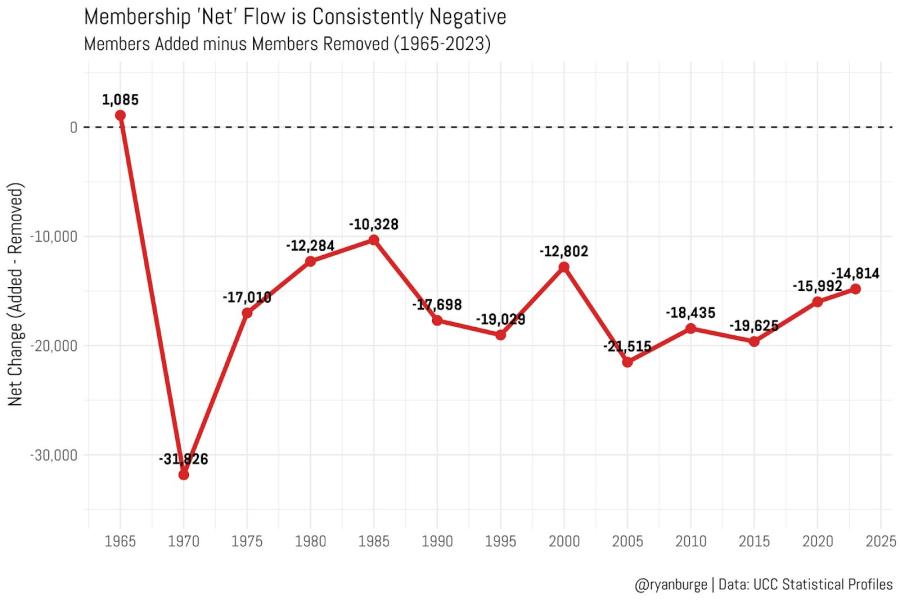
In its series of reports on denominational statistics, the Substack newsletter Graphs about Religion (March 12) notes that the United Church of Christ (UCC) stands out for its lack of positive indicators. Ryan Burge writes that “both congregations and membership have taken an absolute nosedive since the early days of the UCC. It’s pretty apparent that 1960 was the apex of the United Church of Christ, when they boasted about 2.25 million members and over 8,000 churches. From that point forward, decline was the norm. That’s something I want to make crystal clear here: the UCC has been moving in a downward direction for over six decades now.” Current data indicates that the number of congregations has dropped to 4,485, showing a decline of about 46 percent. The most recent membership number for the United Church of Christ is 683,936. “In percentage terms, that’s a dip of just under 70 percent. In 1970, the UCC reported its highest ratio of members to churches: 291 to one. That’s actually a really healthy number. But now the figure has dropped to only 152 members per congregation. In other words, they aren’t closing churches fast enough to keep that ratio up,” Burge writes. The UCC is still losing about 15,000 members per year even as the denomination has slipped to fewer than 700,000 members. Another troubling indicator is that the average UCC church is small; the median in-person worship attendance in 2023 was just 39 people per church, with a median membership of 97.
The “micro-church” began to explode in the United Church of Christ since the 1990s. By 2015, almost half of all UCC congregations averaged fewer than 50 worshippers. In the most recent data from 2023, two in three congregations in the United Church of Christ had weekend attendance between 1 and 50 people. Burge adds that the share of congregations in the United Church of Christ that will have more than 150 people show up this Sunday is 3 percent, which is a total of about 135 congregations. Added to that is clergy data showing about 5,100 active ministers in the United Church of Christ, with about 4,100 who were retired. “If that current trajectory holds steady, there will be more retired UCC ministers than active UCC ministers in the next five to seven years. And with the bulge of Baby Boomers in society, I would put my money on the shorter time frame there.” With fewer and fewer ministers entering the United Church of Christ. there’s a very good chance that if current trends continue, there will be fewer than 50 new people joining the ranks of UCC clergy per year within a decade. Burge concludes that from a purely actuarial perspective, this is a very bad situation. Every single metric is pointing in a negative direction. “Some very difficult decisions will need to be made in the next 15 to 20 years. Real estate agents who specialize in selling abandoned church buildings in New England will have a lot of supply on their hands in the near future,” he writes.

A new study of participants in “Birthright Israel,” a free program to visit Israel, shows a deepening of Jewish loyalties among these individuals compared to those participating in the program before the Oct. 7 terror attacks, reports the website eJewish Philanthropy (March 23). Instead of serving as an entry point for young Jewish adults into the Jewish world, the 10-day trips today are attracting “far more engaged participants, deepening their Jewish identities and ties to Israel,” according to the Brandeis University study. The study examines the participants in last summer’s 10-day trips, comparing them to both the previous year’s participants and to those who attended trips in the summer of 2023, before the Oct. 7 attacks. The study found that the 2025 and 2024 participants were far more engaged, educated about being Jewish, and politically conservative than those in 2023. “October 7 continues to shape American Jewry in numerous ways, and the 2025 Birthright Israel trips illustrate that,” write researchers Leonard Saxe, Graham Wright, Micha Rieser, Shahar Hecht, and Samantha Shortall.
The study, which was largely funded by Birthright, found that more than half of the summer 2025 participants—53 percent—said they were “very connected” to Israel before the trip, compared to the 29 percent who said so in 2023. The share of participants who said they were “a little” or “not at all” connected to Israel decreased from 32 percent in 2023 to 18 percent in 2024 and 2025. Nearly twice as many attended Jewish day schools post-Oct. 7 (40 percent) than pre-Oct. 7 (23 percent). More than three times as many identified as Orthodox in 2024 and 2025 (22 percent and 17 percent, respectively) than in 2023 (5 percent). One of the most notable shifts was in the participants’ political affiliations. In 2023, most participants—57 percent—identified as liberal, while 24 percent said they were “moderate” and 20 percent said “conservative.” After October 7, the proportion of conservative participants roughly doubled to 37 percent in 2024 and 42 percent in 2025. But the trips were found to be particularly influential for liberal participants, deepening their connections to Israel.
Doubts expressed by scholars and others about the reliability of the data underlying a British Bible Society report, The Quiet Revival, were spectacularly confirmed when YouGov admitted that its survey data were flawed, leading the Bible Society to withdraw its report. In an article in The Times of London (March 26), Kaya Burgess reports that the fraudulent respondents finally identified by YouGov were mainly people overseas attempting to claim financial incentives offered for completing surveys, and not automated bots. While several church people had felt encouraged by the report, the reality on the ground mostly didn’t match the claims about a steep rise in church attendance by youth in recent years, that “would have equated to hundreds of thousands of people, particularly young men, suddenly starting to attend services.” Echoing the questioning of the findings by British sociologist David Voas and others, RW had covered the report under the title “Rumors of revival spread—and are doubted” (April 2025). Stressing that the Bible Society had refused for a year to engage with scholars who were raising doubts about the reliability of the data, Voas told the BBC (March 26), “I don't know whether to feel gratified by the vindication or annoyed by the amount of time I wasted in pointing out that the numbers were clearly wrong.”
As BBC religious affairs correspondent Catherine Wyatt observed, the report had a public impact, being mentioned in parliament, covered by the media, and encouraging churches to claim seeing young people “turning to Jesus.” While the fiasco is a clear invitation to listen to sober assessments of single surveys inconsistent with data gathered from solid, patient research work, some reactions in Christian circles reveal desires not to give up hopes, such as that of a Church of England spokesman who, while admitting to The Times that its attendance had not been on the scale of the report, added that there was nevertheless “a genuine openness to Christianity, including among younger people.” Writing in Unherd (March 28), Justin Brierly—whose last book is titled The Surprising Rebirth of Belief in God (Tyndale House Publishers, 2023)—argues the withdrawal is embarrassing but shouldn’t lead to over-correction.
While attendance figures show no broad revival (and overall decline continues), Brierley points to signs of a cultural “vibe shift”: record adult baptisms in France (with more than 20,000 expected at Easter 2026), similar rises in Spain and Scandinavia, booming Orthodox catechumens, UK Westminster diocese’s largest convert intake in 15 years, surging Alpha course attendance, and UK Bible sales jumping from £2.69m in 2019 to £6.3m in 2025. On a similar line, the Bible Society has published a follow-up report, The Quiet Revival one year on: what’s the story? While it contains a clear admission of the YouGov failure, the report doesn’t abandon the “Quiet Revival” framing, pivoting instead to other evidence still considered positive. The new report avoids claiming specific attendance percentages. This looks like a smart rebrand rather than a full retreat. Whether this amounts to a true “Quiet Revival” will depend on the new surveys the Bible Society has promised. Regarding YouGov, it has apologized and will re-run the survey (properly) later in 2026.
(Bible Society, “The Quiet Revival one year on: what’s the story?”)

Whether a scholar holds to the “secularization thesis”—the contested theory that modernization leads to the loss of religious belief, practices, and identity—may be significantly related to one’s own religiosity or secularity, new research finds.Writing in the LSE Impact blog (March 18), Swiss researchers Jaleria Rainero, Jorg Stolz, and Ruud Luijkx note that one group of scholars is “convinced that religion is alive and well, if not in Europe, then everywhere else in the world.” These scholars point to the rise of Christian Nationalism in the U.S., the success of new spiritual and esoteric practices in the West, and Pentecostal revivals in the Global South. The other group disagrees. According to them, religion is on a long-term path of decline, with rising numbers of religiously unaffiliated individuals and empty pews in virtually all countries around the world. This stubborn opposition led the researchers to ask if some of the disagreement might stem, not from the social reality being studied, but from the scholars’ own beliefs.
Rainero, Stolz, and Luijkx created an international database of scholars working on secularization and conducted a survey measuring their personal religiosity and beliefs about religious decline. They then coded their published articles according to whether they supported or challenged the secularization thesis and linked the two datasets. They found the results “striking,” showing “robust evidence of what we call ‘(non-) religious bias’: religious researchers were significantly less likely to find evidence supporting secularization in their publications, while secular (non-religious) scholars were more likely to report findings consistent with religious decline.” The relationship the researchers found between religiosity and beliefs took two forms, then—scholars’ personal religiosity predicted their private beliefs about secularization, but, more unexpected, it also predicted the conclusions in their published academic work. This pattern held even after controlling for research methods, study quality, and the religious and geographic contexts scholars studied. The authors conclude that the findings are more evidence of ideological bias in the production of social scientific knowledge, which could harm public trust in science.

A Family Federation for World Peace and Unification Congregation The schismatic developments within Unificationism are the result of complex structural forces, including environmental conditions, resource competition, niche dynamics, and authority disputes, according to a new study of the Unification movement. The several schisms that have taken shape and survived in Unificationism since the death of its founder Sun Myung Moon in 2012 can best be understood by applying “religious organization ecology” (ROE) theory, a synthetic theoretical framework that combines religious economies theory, new institutionalism, and organizational ecology, according to Steven Foertsch (Nebraska Wesleyan University) and Heewon Yang (Baylor University). Their article in the Wuhan Journal of Cultic Studies (March) also offers useful information about the fragmented Unificationist movement itself. After Sun Myung Moon’s death in 2012, the movement fractured into three main groups: the mainline Family Federation for World Peace and Unification (led by Moon’s widow Hak Ja Han), the World Peace and Unification Sanctuary or “Sanctuary Church” (led by Moon’s son Hyung Jin “Sean” Moon), and the Family Peace Association (associated with another son, Hyun Jin “Preston” Moon). The focus of the article is on the first two groups.
From their theoretical basis, the authors derive three propositions: first, that institutionalizing religions (undergoing a “sect-to-church” shift) become prone to schism; second, that schisms arise from disputes over legitimate authority, which are subsequently rationalized through doctrine; and third, that attempts at niche domination lead to organizational “stretching,” opening space for schismatic groups to establish themselves as niche specialists.
On the first proposition, the authors explain that the 1994 transition from the original church structure to the Family Federation represented a lowering of tension with mainstream society. In their view, the sect-to-church shift undermined the charismatic authority necessary for a unified succession. Internal factions exploited this weakening to contest the appointment of Hyun Jin Moon as heir. On the second proposition, theological disputes between the competing factions are seen as post-hoc rationalizations of power struggles rather than the other way around.
According to the authors, the founder’s widow, Hak Ja Han, developed her “Only Begotten Daughter” theology to sacralize her own authority, while the Sanctuary Church countered by deifying Reverend Moon and denouncing Hak Ja Han as a heretic—positions that hardened only after the underlying authority conflict had already taken shape. On the third proposition, the authors claim that the Unification movement’s syncretic East-West niche, consolidated through innovations such as the mass wedding ceremony, was too broad to sustain. Hyung Jin Moon’s failed attempt to introduce westernized rituals into the predominantly Korean and Japanese membership led to his expulsion. The Sanctuary Church then carved out a specialist western niche, notably through its “Rod of Iron” firearms theology, appealing to American gun-rights culture and attracting a predominantly White Anglo-Saxon Protestant membership—a strikingly different demographic profile from the mainline Family Federation.
The authors conclude that ROE holds genuine promise as a meso-level, comparative research program applicable beyond high-tension groups to schisms within mainstream denominations, citing the contemporary Methodist schism as a recommended next case.
(Wuhan Journal of Cultic Studies)
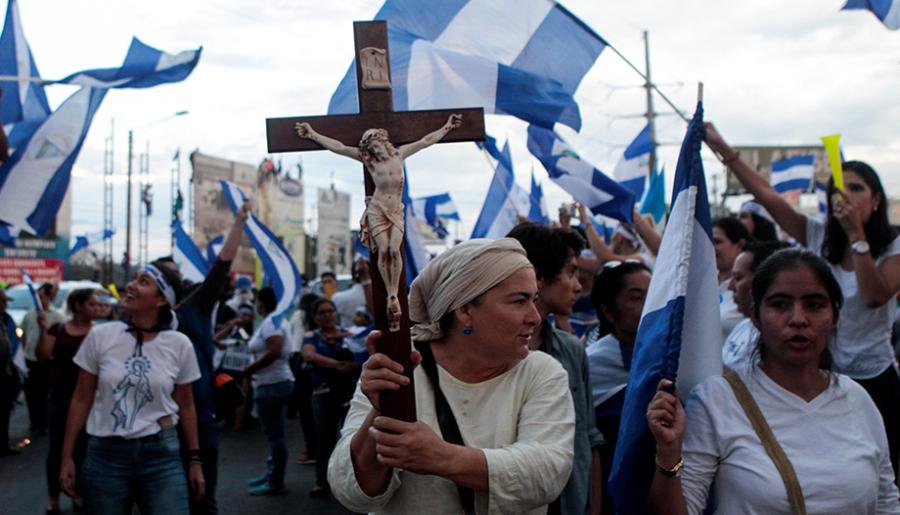
Marching for religious freedom in Nicaragua A complex picture of religious freedom in Latin America is emerging, where steps forward in guarding religious liberty co-exist with threats of violence, repression, and criminal corruption in politics, according to the 2025 Annual Report of OLIRE (the Observatory of Religious Liberty in Latin America). Religious freedom is threatened from forces that range from authoritarian governments to armed groups and from criminal networks to ideological campaigns to silence or delegitimize religious expression. In his newsletter Bitter Winter (March 20), Massimo Introvigne cites the OLIRE study as taking a comprehensive approach to religious freedom, encompassing the ability to live out one’s beliefs in family life, education, work, cultural expression, and public engagement. At the same time, the report “supports the separation of religion and state but also affirms that religious groups have a legitimate place in public debate, provided they do not seek to impose their beliefs on others,” Introvigne writes.
The political and social situations in countries such as Cuba, Nicaragua, and Venezuela show how delicate this balance is, as they impose repressive measures against dissenting religious voices, using broad legal frameworks to intimidate, surveil, and control religious communities. The report adds that in these countries critical religious expressions are portrayed as threats to political stability, with religious leaders who oppose state policies facing “arbitrary detention, interrogations, fines, threats, constant surveillance, and restrictions on their mobility.” In Nicaragua, the state organizes public religious events to gain credibility among certain sectors while delegitimizing independent voices, such as the Catholic Church. The situation in Venezuela is more mixed, but Introvigne adds that the report observes that “authorities promoted a selective relationship with specific religious communities, particularly evangelical churches, offering administrative benefits or public visibility in exchange for political loyalty.” Meanwhile, violence remains a persistent threat to religious communities across the region. Colombia’s armed groups, such as FARC dissidents, ELN, and criminal gangs, continue to target religious leaders and communities in the regions of Cauca, Catatumbo, Guaviare, and Meta. Mexico faces similar criminal targeting of religious leaders, congregations, and events. The report notes that “temples and religious events are no longer perceived as neutral or protective spaces in the face of generalized violence.”
Criminal groups view religious institutions as obstacles to their territorial and social control. Introvigne reports that “Haiti offers perhaps the most extreme example of religious communities under siege. Armed gangs dominate large urban zones, abducting, extorting, and attacking religious figures and institutions.” Beyond physical violence, the report finds that religious freedom faces restrictions through legal repression, social hostility, and ideological suppression. For instance, in Colombia and other countries, tensions over religious symbols and speech have led to censorship or self-censorship in the concern about discrimination, particularly on issues related to family, life, and morality. Indigenous communities face distinct pressures and vulnerabilities. The report focuses on how these groups’ spiritual practices are inseparable from their collective identity, territorial rights, and traditional ways of life. “In many indigenous worldviews, territory holds a sacred character,” and violations of land rights are experienced as spiritual transgressions, Introvigne reports.
(The OLIRE report, Bitter Winter)
Ireland has retained much of its Catholic faith, despite reports of rapid secularization in the country, according to a new study. Acknowledging sharply declining priestly vocations and church attendance, the study’s authors, Stephen Bullivant and Emily Nelson, find that data from 2023–2024 shows “a strong uptick in religious affiliation and religious practice,” which is “most strongly evident among those aged 16–29 years, across both Catholics and Protestants.” [The January issue of RW reported on more anecdotal sources suggesting a growing religious interest among Irish Generation Z]. The report finds that Ireland remains one of the most practicing Catholic countries in Europe, with the fourth highest percentage of weekly Massgoers among baptized Catholics, behind Poland, Slovakia and Italy. Religious affiliation also remains relatively strong, with Ireland having one of the lower rates of non-affiliation in Western Europe.
Northern Ireland remains the most religiously observant part of the United Kingdom and of the island of Ireland, with more than 40 percent of Catholics attending Mass weekly or more, according to the study. Close to 70 percent of Northern Ireland identifies as Catholic or another form of Christian, whereas just 37 percent do so in the United Kingdom as a whole. The non-affiliation rate is only 24 percent in Northern Ireland, compared to 32 percent in the Republic of Ireland. This recent growth in Ireland is showing some signs of revitalization in parishes. The Archdiocese of Dublin is set to receive a record number of converts into the church this Easter. Some 129 catechumens and candidates will be received into the church in Ireland’s largest diocese, which serves almost one million Catholics, on Easter Saturday. This marks an increase from last year’s class of 80, and an even greater rise from the pre-Covid number of 22 who presented themselves in early 2020. Archbishop Eamon Martin, Archbishop of Armagh and Primate of All Ireland, admitted, “I don’t think we should get ourselves too excited thinking this is a complete reversal of the very obvious decline in religious practice over the last 10 or 20 years.” But he also acknowledged that the report “is seeing something.”
(Download The report)