

Bottling the sacred: Christian energy drinks and beyond
The lucrative market of celebrity- and influencer-endorsed beverages has expanded into religious branding with the emergence of dedicated Christian energy drinks, writes Lydia Bugg in The Guardian (June 4). As Anna Rees Green remarks, the U.S. soft drinks market is worth an estimated $460 billion, according to Mintel’s 2025 report (Premier Christian News, June 5). Capitalizing on the low-risk and profitable nature of the beverage industry, brands like Yahweh, Agape, 4gvn, and Praise
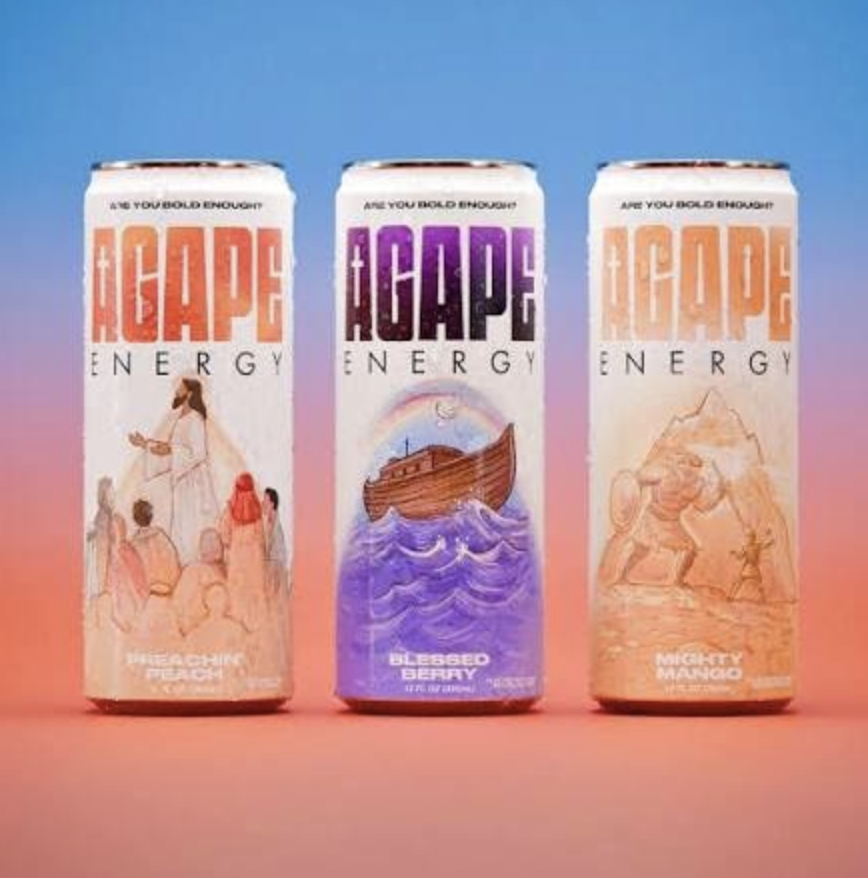
Energy are building products entirely around Christian imagery and messaging. While the creators of these drinks claim their main mission is to spread the gospel and raise brand awareness for Christianity, critics and reviewers question whether they are simply using a figure with universal recognition for financial gain. When Christian influencer Bryce Crawford launched Praise Energy, “social media platforms, particularly TikTok, [were] flooded with videos from Christians accusing Crawford of commodifying the Gospel,” writes Aiza Moraña (International Business Times UK, January 24). She remarks that Crawford’s move “has left a lot of people in the religious community wondering if the boundary between ministry and marketing still exists.”
Brands like Agape lean heavily into active evangelism by including cardboard gift boxes with their cases. Yahweh drinks carry Bible verses “on every can,” and aim to be “conversation-starting,” Green writes. The website of this self-described “first Christian energy drink” proclaims: “Yahweh Energy is more than a drink—it's a bold invitation to live your faith out loud.” Some promoters use additional arguments, with Crawford, for example, claiming that he also wants “to make a cleaner option on the energy drink market” (CNN, June 9). It is not the first time that one sees entrepreneurs launching beverages associated with religious symbols. In the first decade of the 21st century, Mecca Cola was launched in France and Qibla Cola in the UK, but none developed as expected. But some energy drinks in Muslim countries also seem to be following the lead. In 2024, a team of researchers at FATA University (Pakistan) wrote an article examining the advertising discourse of Shilajit Energy Drink by influencer Shahid Anwar (Pakistan Journal of Social Sciences Review, December). Umair Ahmad, Muhammad Imran, and Bilal Khan observed how the brand’s social media advertisements purposefully incorporated highly revered religious and cultural elements—specifically Zamzam water, Shilajit (a substance heavily used in South Asian cultures and known for its traditional health benefits), and Zafran (Saffron)—to manufacture an emotional appeal tailored to Muslim consumers. Their conclusion might also apply to Christian energy drinks: “The advertisement blurs the distinction between the sacred values and the commercial by transforming spiritually significant morals into promotional materials, therefore reinforcing the ideological convergence of consumerism and faith.”